Filters
Thank you! Your submission has been received!
Oops! Something went wrong while submitting the form.
Our products


.png)


No results available.
There are no results with these criteria. Try changing your search.


Yes, Kaspa (KAS) can be mined and ranks among the most actively mined proof-of-work coins of recent years - the network runs on proof of work like Bitcoin and depends permanently on miners. It is mined using the kHeavyHash algorithm with specialized ASIC miners such as the Antminer KS7, which provide computing power around the clock and in return receive new KAS as a block reward.
Kaspa's distinctive feature is its BlockDAG structure: instead of a single chain with one block every ten minutes, Kaspa has produced roughly ten blocks per second since the Crescendo upgrade. In principle anyone with suitable hardware and a power connection can take part; how this works in detail is covered in the questions below as well as in our Kaspa miner overview.
Kaspa (KAS) is a proof-of-work cryptocurrency that launched in 2021 without any pre-sale or premine and is mined using the kHeavyHash algorithm. Its hallmark is high speed: instead of a single chain, Kaspa uses a BlockDAG structure (GHOSTDAG protocol) in which multiple blocks are processed in parallel.
As a result, the network has produced roughly ten blocks per second since the Crescendo upgrade and confirms transactions accordingly fast, while retaining the proof-of-work principle known from Bitcoin. For miners, the key point is that KAS can only be mined economically with dedicated kHeavyHash hardware - the next questions cover the details.
Kaspa stands out from the start by its pace: instead of one block every ten minutes, roughly ten blocks are created per second. This is made possible by the BlockDAG structure (GHOSTDAG), which does not discard blocks found at the same time but arranges them in parallel and brings them into a shared order.
The actual work behind it is classic proof of work: kHeavyHash ASICs such as the IceRiver KS series continuously compute cryptographic tasks, and whoever finds a valid solution contributes a block and receives KAS for it. Because of the high block frequency and network difficulty, most miners pool their power in a pool like ViaBTC or 2Miners, since a single device on its own rarely gets its turn. This is how new KAS enter circulation and the network stays protected against manipulation.
Kaspa runs on the kHeavyHash algorithm, so you absolutely need an ASIC specialized for it - a KAS miner is not interchangeable with Bitcoin or Litecoin devices. You are ready to go in four steps:
1. Hardware: choose a kHeavyHash ASIC such as the Antminer KS5 Pro (~21 TH/s) or the more powerful KS7. You can see which models we carry in the Kaspa miner category.
2. Wallet: set up a Kaspa wallet (e.g. Kaspium or the KasWare browser wallet) - this is where your payouts go.
3. Pool: connect the miner to a pool like ViaBTC via the web interface and enter your wallet address as the payout destination.
4. Location: decide whether the device runs at home or with us in hosting - Kaspa devices are loud and power-hungry, which quickly becomes an issue at home. Before buying, run your electricity price and expected KAS yield through a mining calculator.
Kaspa mining is based on the kHeavyHash algorithm - the cryptographic computing task that every Kaspa ASIC is hard-wired for. kHeavyHash combines a matrix computation with a hashing step and is therefore tailored specifically to ASIC hardware.
Today kHeavyHash is fully dominated by devices like the Antminer KS7 or the IceRiver KS models; graphics cards stand no chance. Other coins partly use entirely different algorithms (Bitcoin SHA-256, for example, Litecoin Scrypt), which is why their hardware is no good for Kaspa and vice versa. Anyone wanting to mine KAS needs kHeavyHash hardware specifically.
Kaspa and Bitcoin share the proof-of-work principle but differ in two key respects. First, Kaspa uses a BlockDAG structure (GHOSTDAG) that processes blocks found in parallel, whereas Bitcoin forms a single chain with one block roughly every ten minutes - as a result Kaspa produces around ten blocks per second.
Second, the two rely on different algorithms: Bitcoin on SHA-256, Kaspa on kHeavyHash. That is why each coin requires its own dedicated hardware - a Bitcoin miner cannot mine Kaspa, and an Antminer KS7 conversely cannot mine Bitcoin.
For Kaspa mining you need kHeavyHash ASIC miners - devices whose chips are built exclusively for the Kaspa algorithm and therefore deliver many times the computing power per watt compared to graphics cards. Common industrial devices are the Antminer KS7 from Bitmain with around 40 TH/s at about 3.1 kW (77 J/TH) and the cheaper Antminer KS5 Pro with 21 TH/s; alongside these there are IceRiver KS models and older iBeLink devices.
ASIC stands for application-specific integrated circuit: such a device handles only kHeavyHash, but does so especially efficiently. That is exactly what it takes today to stay competitive in the Kaspa network. You can find the currently available models in our Kaspa miner category.
Kaspa (KAS) started out as a pure GPU coin, but today mining with a graphics card is no longer worthwhile - the kHeavyHash ASICs have driven difficulty up so far that GPUs have fallen behind.
An Antminer KS7 achieves around 40 TH/s at about 77 J/TH, many times what even a fast gaming graphics card reaches. Anyone still mining KAS with a GPU ends up paying far more for electricity than comes in from Kaspa. The shift from GPU to ASIC mining happened particularly fast with Kaspa - today there is no way around a Kaspa ASIC for serious KAS mining. Whether it pays off is best checked daily with a mining calculator.
For Kaspa mining with a kHeavyHash ASIC such as the Antminer KS7, you do not install any separate software - the control is part of the device firmware. In the browser you open the web interface, enter a Kaspa pool like ViaBTC or 2Miners and your Kaspa wallet address, and the KS7 starts hashing.
In Kaspa's GPU early days a dedicated miner software was still needed; with the switch to kHeavyHash ASICs this is no longer the case. If you run several KS devices, monitoring software can make it easier to keep track - for a single KS7 the bundled firmware is enough.
Various kHeavyHash ASICs from well-known manufacturers are available to buy - in the industrial segment above all the Antminer KS series from Bitmain, plus IceRiver KS models and older iBeLink devices. Among the most sought-after devices are the Antminer KS7 (around 40 TH/s, approx. 3.1 kW) as the flagship and the somewhat cheaper Antminer KS5 Pro with 21 TH/s; alongside these there are compact home devices such as the KS7 Lite.
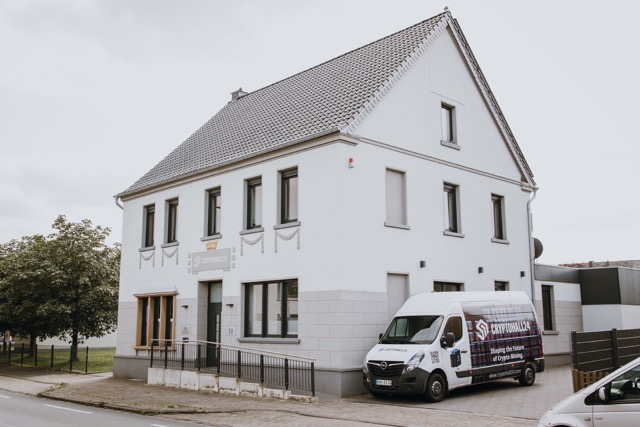
At Cryptohall24 you order these Kaspa miners directly - new or as a tested used device. Which model suits you depends on whether you want to mine at home or have it hosted and on how high your budget is; you can find the currently available models at the top of this page.
Here it is mainly the device generation that decides: a smaller or older KS3 can be had for a few hundred to a few thousand euros, while the current industrial ASIC Antminer KS7 (around 40 TH/s) sits at the upper end of the Kaspa scale. The jump in price mirrors the jump in hashrate (TH/s) and efficiency (J/TH).
With Kaspa in particular, a close look pays off: a seemingly cheap older device can end up costing more in continuous operation due to its higher power consumption than a more efficient KS7 - the purchase is only one part of the calculation alongside electricity price and KAS yield. The current daily prices of the individual models are at the top of this page.
With Kaspa, the efficiency spread between generations is enormous - and the used-device decision hinges precisely on that. A used Antminer KS7 at around 77 J/TH is nearly as efficient as new and delivers its roughly 40 TH/s on kHeavyHash. Alongside new devices, Cryptohall24 also carries tested used KS models.
The older KS3 is quite different: at roughly 400 J/TH it draws five to six times the power per TH and is practically only worthwhile with very cheap electricity or a correspondingly low purchase price. The economics therefore come down to the price difference, the J/TH value and your electricity price - we advise you on this and show you suitable Kaspa miners.
Anyone who buys KAS owns the coins immediately at the current price via a crypto exchange like Bitget or Binance. Anyone who mines KAS runs a kHeavyHash ASIC and receives block rewards continuously over time.
Kaspa stands out here through its extremely fast BlockDAG protocol with several blocks per second - this keeps the rewards small-grained and makes a strong hashrate and a low electricity price decisive for profitability. Buying is therefore the direct entry via the price, mining is the continuous production, whose result depends on electricity price, KAS price and difficulty. Cryptohall24 sells the kHeavyHash hardware and offers hosting; the KAS trading itself is handled by the exchanges.
A home miner is a Kaspa miner designed for operation at home - quieter, more compact and more efficient than the large industrial ASICs for data centers. It delivers less computing power but can be run in a normal living environment; one example is the compact Antminer KS7 Lite with around 4.2 TH/s at only about 500 watts.
Home miners suit beginners who want to try out Kaspa mining or run it on a small scale. Unlike with many other coins, Kaspa has its own class of compact, very quiet devices, while the high-performance KS industrial models (KS5 Pro, KS7) are generally too loud for living spaces.
With Kaspa, the cooling type depends on the device: the kHeavyHash ASICs of the KS series come both air-cooled and hydro-cooled. Air-cooled models like the Antminer KS7 dissipate their waste heat via powerful fans and are the standard for individual setups and home operation.
Hydro miners such as the KS5L Hydro line instead dissipate the heat via a closed water circuit. This makes them noticeably quieter and allows a higher power density in tight spaces, but requires its own hydro infrastructure with pumps and a dry cooler - which is why they are found almost exclusively in larger data centers. Anyone wanting to buy an Antminer KS7 is best served at home with the air-cooled variant.
A Kaspa industrial miner is loud - an air-cooled ASIC like the Antminer KS7 reaches around 75 dB in operation, roughly the level of a running vacuum cleaner, because its fans have to dissipate the waste heat of a good 3 kW in continuous operation. An ordinary living space is usually unsuitable for this.
There are, however, quieter alternatives: home miners built specifically for home use, like the Antminer KS7 Lite, run noticeably more muted. Anyone wanting to avoid the noise of a large KS device entirely places it in a quiet spot such as a basement or garage - or has it hosted in a data center, where the volume does not matter.
You mine Kaspa with the Antminer KS7 or KS5 Pro - but the mined KAS are stored in a Kaspa wallet that is independent of the hardware. You enter its address in the pool; without it the payout has no destination.
Free standard wallets are, for instance, KasWare or the official Kaspa wallet - both give you the receiving address and a private key that belongs only to you. For larger KAS holdings, a hardware wallet like Ledger is additionally recommended, which supports KAS via a compatible app and secures the keys offline.
A mining pool is a combination of many miners who pool their computing power and split the block rewards they find proportionally. This way you regularly receive small KAS payouts instead of waiting a long time in vain for a block of your own - the pool charges a small fee for this.
With Kaspa, a pool makes sense for almost all miners, because the network produces very many blocks per second and a single device rarely gets its turn solo. An Antminer KS7 can be connected to established Kaspa pools like ViaBTC or NiceHash, with which we cooperate and through whose link you receive reduced fees.
Kaspa can be mined in several large pools - these include ViaBTC, NiceHash, 2Miners, K1Pool and F2Pool, with fees of usually 0 to 2 percent. One distinctive feature shapes the pool choice with Kaspa: the network produces around ten blocks per second, which is why a pool server with low latency produces noticeably fewer stale shares.
We work directly with ViaBTC and NiceHash; signing up through our links lowers your pool fees there. Since shares and terms shift constantly, a current comparison at the respective provider pays off before choosing.
With Kaspa, an additional criterion decides the best pool that other coins do not have: latency. Because the network produces around ten blocks per second, the pool server should be geographically close so that as few submitted solutions as possible become stale - only after that come fee, payout model and minimum payout.
For getting started, ViaBTC and NiceHash are suitable, with which we cooperate and through whose links you receive reduced fees. Where possible, choose the server with the lowest ping time to your location and check the fees daily.
Kaspa is technically solo-mineable, but the coin's architecture makes it especially unpredictable: via the BlockDAG structure, around ten blocks are created per second, and your single Antminer KS7 competes against a very high total network hashrate.
In practice this means many blocks, but a vanishingly small share of them for you - long stretches without a hit are then normal, even though one find brings the complete reward. Anyone wanting steady KAS yields therefore mines via a pool like ViaBTC. Solo only becomes interesting once you pool a great deal of computing power across several KS7 units.
With Kaspa mining, electricity often accounts for 50 to 70 percent of total costs and is thus by far the largest ongoing cost factor. The widespread kHeavyHash ASIC Antminer KS7 draws about 3.1 kW; in continuous round-the-clock operation that is roughly 27,000 kWh per year.
How high the consumption turns out exactly is decided by the efficiency in J/TH: a KS7 sits at around 77 J/TH, older KS3 devices at about 400 J/TH. The electricity price is therefore the most important profitability lever - at household electricity around 30 ct/kWh, continuous operation becomes expensive, which is why mining is often done at locations with cheap energy.
No, Kaspa does not halve its mining reward abruptly like Bitcoin, but reduces it smoothly and continuously. This model is called chromatic emission: the reward drops every month in small steps, so that the payout halves over the course of each year - without the abrupt cut of a classic halving.
For Kaspa miners this means a gentle, predictable decline in the KAS paid out per unit of computing power instead of a sudden jump on a fixed date. As with other proof-of-work coins: the further the emission falls, the more important the efficiency of the hardware (J/TH) and a low electricity price become.
The total supply of Kaspa is capped at around 28.7 billion KAS; more can technically never come into existence. A very large portion of that is already mined, the remaining amount is added gradually over the coming years through the continuously falling chromatic emission.
A distinctive feature of Kaspa is its fair start: there was no pre-sale, no premine and no allocations to founders or investors. All KAS are issued exclusively through mining - comparable to the principle of Bitcoin. For miners this means that every new KAS on the market was created through computing power.
Kaspa is among the fastest proof-of-work networks: since the Crescendo upgrade in May 2025 it produces around ten blocks per second - by comparison, with Bitcoin a block is created only about every ten minutes.
This is made possible by the BlockDAG structure with the GHOSTDAG protocol, which orders multiple blocks found in parallel instead of discarding them as in a classic blockchain. For the user this means very fast transaction confirmations; for Kaspa miners, a stable, low-latency internet connection is therefore more important than with slower coins, so that submitted solutions do not become stale.
Whether Kaspa mining is worth it in 2026 depends above all on three factors: the KAS price, the network difficulty and your electricity price. Kaspa is technically fully mineable, but margins have become tighter because the network hashrate has risen sharply and emission is declining due to the chromatic model.
With cheap electricity and an efficient device like the Antminer KS7 (77 J/TH), profitable mining is possible under the right conditions; with expensive household electricity the calculation quickly tips into the red. You calculate your scenario most reliably in advance with a current mining calculator like AsicMinerValue, which takes the KAS price and difficulty into account daily.
Kaspa uses a continuous, monthly decreasing emission instead of abrupt halvings - so the block reward falls steadily. This means: what an Antminer KS7 brings in KAS today tends to be more than in a few months, regardless of price and difficulty.
The net earnings remain the mined KAS amount times price, minus electricity costs and pool fee. With cheap electricity the KS7 (kHeavyHash) yields a profit, with expensive electricity the calculation tips over. Since price and difficulty vary daily, you estimate your yield most reliably with a daily mining calculator for the KS7.
Kaspa stands out because the network hashrate grows particularly fast due to the high block frequency and the broad ASIC adoption - this is exactly what continuously pushes down how much KAS a device earns per day. What matters is the ratio of your kHeavyHash hashrate to the network difficulty plus your pool share; an Antminer KS7 delivers around 40 TH/s.
Since the KAS price also fluctuates, there is no fixed daily amount. The expected gross yield with your hardware can only be estimated with a current mining calculator; after deducting electricity costs, your net yield remains.
The decisive factor with Kaspa is the network difficulty: it has risen sharply with the switch to ASICs and pushes down the yield per device. A mining calculator processes exactly that - you enter hashrate and consumption (for the Antminer KS7 about 40 TH/s and around 3.1 kW) plus your electricity price, and it determines the estimated daily or monthly yield using the current KAS price and difficulty.
At AsicMinerValue the common kHeavyHash models are listed with daily profitability. Since price and difficulty are constantly in motion, every figure is only a snapshot - check your scenario again shortly before buying.
With Kaspa mining at home, it depends heavily on the model. The regular kHeavyHash ASIC Antminer KS7 draws around 3 kW and is loud - more something for a basement or garage. But with the KS7 Lite there are deliberately quieter, throttleable home variants that bring self-operation into the living area.
Regardless of the device, the electricity price remains the biggest lever. At household electricity around 30 ct/kWh continuous operation usually runs at a loss; with cheap electricity or your own solar power from a photovoltaic system, Kaspa mining at home pays off much sooner. When it comes to high quantities or maximum profitability, hosting in a data center is still usually superior.
With Kaspa mining, heating depends heavily on the device. A quiet home miner like the KS7 Lite can even be run in a living space and gives off its absorbed power as readily usable heat while it produces KAS via kHeavyHash - ideal for a home office.
A full industrial ASIC like the Antminer KS7 with around 3.1 kW, on the other hand, heats strongly but, with its volume, is more a case for a basement or workshop. Either way: in principle a Kaspa miner converts the absorbed energy almost entirely into heat. Heating operation becomes economically interesting above all with cheap electricity or your own photovoltaics, because the KAS yields then offset part of the electricity costs.
With Kaspa, the adjustment rhythm stands out above all: because the network produces around ten blocks per second on the BlockDAG structure, the difficulty is readjusted virtually continuously - one of the fastest difficulty adjustments there is.
The difficulty is the measure of how demanding it is to find a valid block in the kHeavyHash network. If the total hashrate rises, the network raises the difficulty almost in real time so that the high block rate stays constant; if it falls, it is eased again.
Kaspa's difficulty has risen sharply since the launch of the KS series ASICs. For you this means: the higher it stands, the less KAS falls per day to a single device - a central factor for the question of whether your electricity price holds up.
Kaspa mining with the Antminer KS series can be handled as hosting at Cryptohall24: we operate your kHeavyHash industrial devices - such as the KS5 Pro or KS7 - in the data center, you remain the owner and do not have to worry about space, power and cooling.
What is decisive here is the device class: Bitmain KS machines are genuine industrial ASICs and therefore hostable, whereas we generally do not accept IceRiver devices. At a professional location, the home-related issues around 75 dB noise and high household electricity costs also disappear. How to assess a suitable host is explained in the mining hosting guide.
From the Kaspa lineup, Cryptohall24 hosts the Bitmain KS series - kHeavyHash industrial devices like the KS5 Pro (21 TH/s) and the KS7 (around 40 TH/s at approx. 3.1 kW), which are designed for 24/7 data center operation.
Two groups stay out: all IceRiver devices on principle, as well as very efficient models like the KS7 Lite, which target home operation - we are happy to sell and explain these, but do not host them. Which of your specific Kaspa devices gets a space we are happy to clarify on a case-by-case basis.
Whether Kaspa mining is permitted is answered by each country individually - in Germany it is allowed. Anyone who works here regularly and with a profit motive using the KS miners is considered a commercial trader for tax purposes, which is why the KAS earned count as taxable income. Conversely, the expenses for electricity consumption, hosting and devices reduce the taxable profit. Abroad the rules look different; the specifics of your situation are best discussed with a tax advisor. This is a rough classification and does not replace advice.
No - a Kaspa miner stays limited to kHeavyHash coins, and that is practically only Kaspa itself. A few smaller projects share the algorithm, but play hardly any economic role.
The Antminer KS7 cannot mine Bitcoin (SHA-256) or Litecoin (Scrypt), because its chips are manufactured firmly for kHeavyHash and cannot compute any other algorithm. Anyone wanting to mine a coin with its own algorithm needs the matching device for it - an overview by coin is provided by the ASIC miner category.