Filters
Thank you! Your submission has been received!
Oops! Something went wrong while submitting the form.
Unsere Produkte
No results available.
There are no results with these criteria. Try changing your search.

Alephium's BlockFlow protocol enables parallel transactions and better scalability, which increases mining efficiency and confirms transactions faster.
Yes, Alephium (ALPH) can be mined and ranks among the more serious proof-of-work cryptocurrencies of the newer generation - the mainnet has been live since November 2021. It is mined using the Blake3 algorithm with specialized ASIC miners such as the Goldshell AL-Box or the IceRiver AL3, which provide computing power around the clock and receive new ALPH as a block reward in return.
The Alephium speciality is its Proof of Less Work (PoLW) consensus, which significantly reduces power consumption compared with classic proof of work, along with the BlockFlow sharding method. How mining works in detail, what hardware is required and what matters when choosing a pool and wallet is covered by the questions below and by our Alephium miner overview.
Alephium (ALPH) is a layer-1 blockchain with smart-contract capability whose mainnet launched in November 2021. The project combines the UTXO model and proof of work known from Bitcoin with Ethereum-style smart contracts and positions itself as a scalable, energy-conscious platform for decentralized applications.
For miners, Alephium is interesting above all because the network is secured by proof of work via Blake3 ASICs and brings two technical peculiarities that set it apart from other ASIC coins: Proof of Less Work (PoLW) and the BlockFlow sharding method. Which devices are suitable for this is shown in our Alephium miner category.
Alephium deliberately caps the power appetite of mining: via the Proof of Less Work (PoLW) mechanism, the required computing work drops as soon as too much hashrate pushes into the network - part of the security then runs via staked coins rather than via pure computing power.
The basis is still proof of work: Blake3 ASICs such as the Goldshell AL series continuously solve cryptographic tasks, and whoever contributes to the solution receives ALPH proportionally. Because a single device on its own very rarely finds a block, almost all miners bundle their Blake3 hashrate in a pool such as HeroMiners or F2Pool. Mining thus brings new ALPH into circulation and secures the network against manipulation.
Alephium mining is based on the Blake3 algorithm - the cryptographic computing task that every Alephium ASIC is hard-wired to; accordingly, you need specialized Blake3 ASICs such as the Goldshell AL-Box or the IceRiver AL3 to keep up economically.
Blake3 is a particularly fast hash function. Other cryptocurrencies use partly completely different algorithms (Bitcoin, for example, SHA-256), which is why their hardware is unsuitable for Alephium and vice versa. Important for context: Blake3 is only part of the picture - Alephium combines it with the Proof of Less Work (PoLW) consensus method that controls energy use.
Proof of Less Work (PoLW) is the consensus method with which Alephium lowers the energy use of its proof-of-work mining - according to the project by over 87 percent compared with pure proof of work. Instead of letting the computing work needed for a block grow without limit alongside network performance, Alephium limits it dynamically.
Technically, the mechanism only kicks in above a certain hashrate: if computing power in the network rises sharply, part of the effort is no longer provided through additional energy but through contributing (burning) ALPH. For you as a miner, this changes nothing about operating the Blake3 ASIC - you continue to deliver hashrate to a pool. PoLW is above all the argument with which Alephium claims energy-conscious proof of work for itself. We explain the background in our article Alephium and Proof of Less Work.
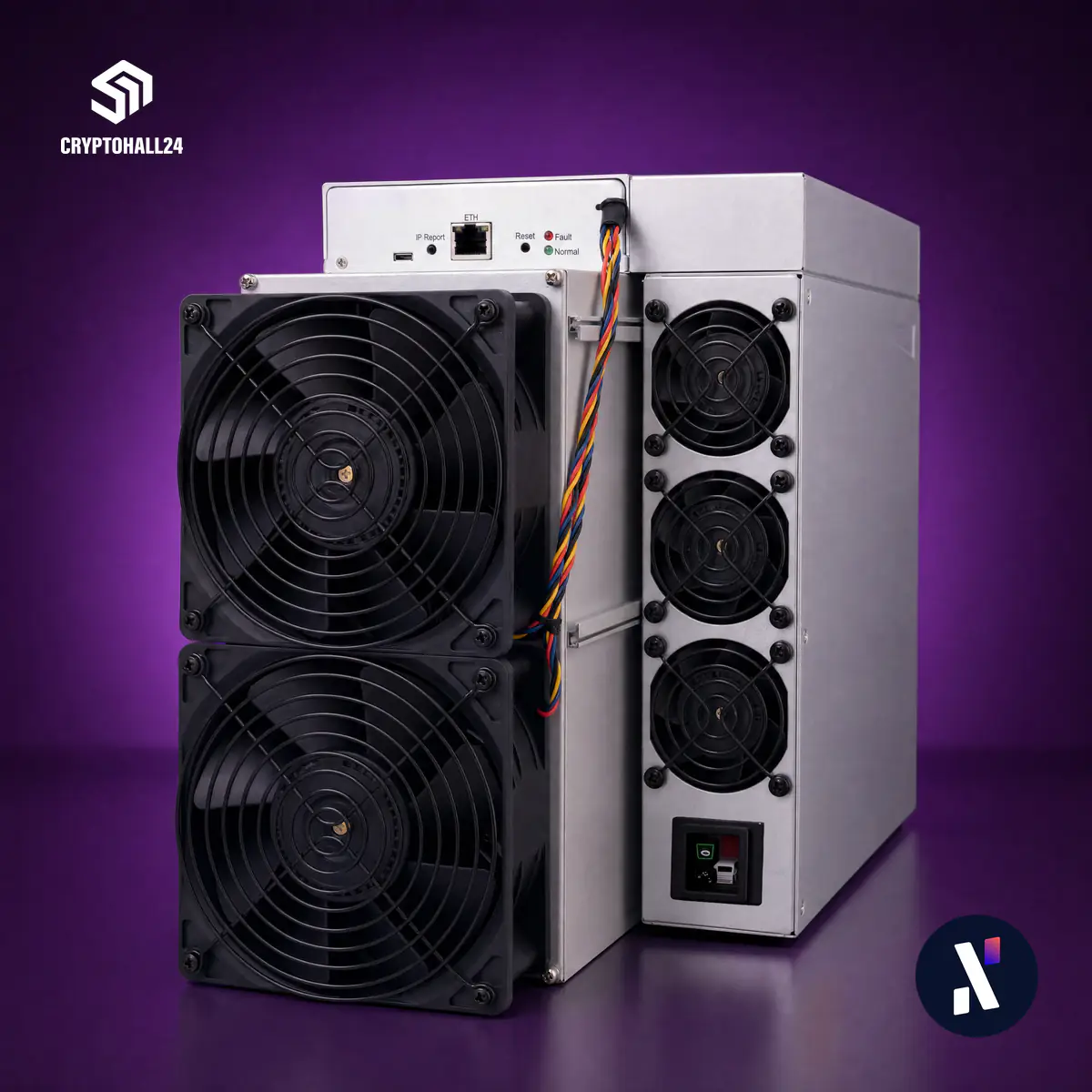
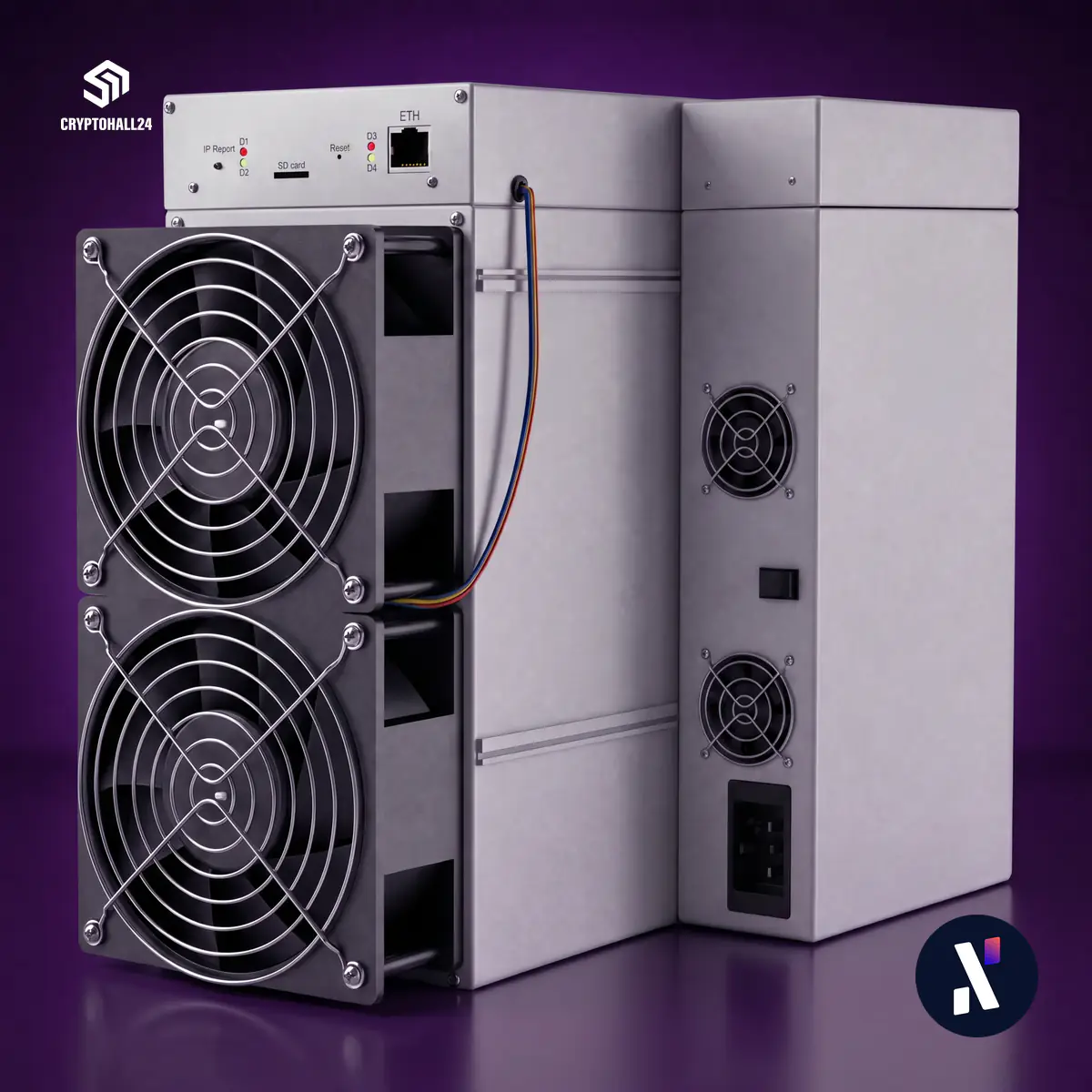
For Alephium mining you need Blake3 ASIC miners - devices whose chips are built exclusively for the Alephium algorithm and therefore deliver many times the computing power per watt compared with graphics cards. With Alephium, the range spans from powerful models such as the Antminer AL1 or the IceRiver AL3 to small, quiet home devices such as the Goldshell AL-Box or the IceRiver AL0.
ASIC stands for application-specific integrated circuit: such a device only handles Blake3, but does so particularly economically. Which variant makes sense depends on electricity price, location and budget. You will find the currently available models in our Alephium miner category.
In the early years, Alephium (ALPH) could also be mined with graphics cards; today this no longer pays off - since specialized Blake3 ASICs such as the IceRiver AL3 or the Goldshell AL-Box exist, GPUs and PCs stand no chance in the competition.
The reason lies in the competition within the network: a modern Blake3 ASIC is orders of magnitude faster and more efficient than even a high-performance graphics card. Anyone who still tries with a GPU ends up paying considerably more for electricity than comes in as ALPH. For serious Alephium mining there is no way around ASICs today.
Alephium (ALPH) uses the Blake3 algorithm, and the matching ASICs - the Goldshell AL-Box or the IceRiver AL3 - come with their control software pre-installed from the factory. So you install nothing: in the browser you open the device interface, enter an ALPH pool such as HeroMiners or K1Pool and your Alephium wallet address, and mining begins.
A GPU variant of Alephium does exist with corresponding software, but it is hardly competitive anymore against the Blake3 ASICs. For operating several devices, monitoring software can optionally be added.
Various Blake3 ASICs are available to buy - in the higher-performance range above all the Antminer AL1 including its AL1 Pro variant as well as the IceRiver AL3, plus small home devices such as the Goldshell AL-Box and the IceRiver AL0 for quiet operation at home. They differ above all in hashrate (GH/s) and efficiency; you will find the currently available models at the top of this page.
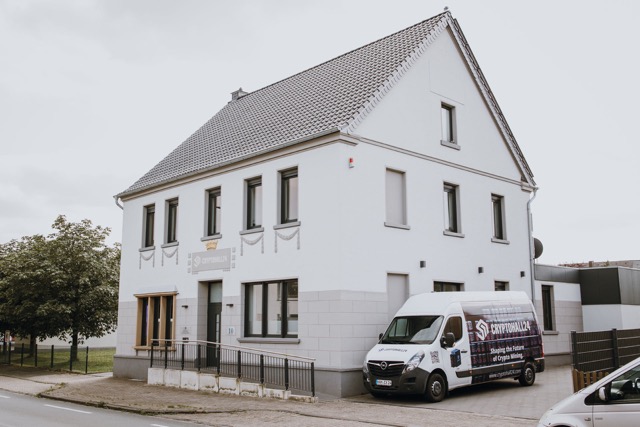
At Cryptohall24 you order the right Alephium miners directly - new or as a tested used device. Which model suits you depends on whether you mine at home, how high your budget is and how much noise tolerance you have; we are happy to advise you on this.
Alephium covers a broad Blake3 device class: from the compact home miner such as the Goldshell AL-Box or the IceRiver AL0 in the lower three-digit to low four-digit range up to more powerful ASICs such as the Antminer AL1 or IceRiver AL3 further up. What matters is hashrate in GH/s and efficiency.
The small Goldshell and IceRiver devices make entry into Alephium comparatively cheap, but draw less hashrate; the large model costs more but delivers more performance per watt. Which variant pays off results from purchase price, electricity costs and ALPH yield together. The daily updated model prices are at the top of this page.
Whether a used Blake3 ASIC such as the Antminer AL1 or a Goldshell AL-Box is suitable for Alephium can be read from the J/GH value: a well-maintained device delivers the full hashrate, but older models do so at worse efficiency. Alongside new devices, Cryptohall24 also offers tested used devices for Alephium.
The more watts a device draws per GH/s, the more strongly its yield hinges on a low electricity price - with expensive electricity, a cheap but inefficient machine quickly loses its advantage. The used option makes sense above all when the price gap to new hardware and the electricity price fit together. We assess this with you and show available Alephium miners.
Alephium is mined with a Blake3 ASIC that continuously pays out block rewards; Alephium is bought ready-made at the current price via a crypto exchange such as Bitget, provided ALPH is traded there. As a still-young project, availability on exchanges is more limited than with established coins - it is worth checking tradability before buying.
Buying is the immediately effective, purely price-dependent route. Mining is the ongoing generation, whose result depends on electricity price, ALPH price and difficulty. Cryptohall24 sells the Blake3 hardware; the ALPH trading itself is handled by the exchanges - our crypto exchange comparison compares possible options.
A home miner for Alephium is a device designed for operation at home - quieter, more compact and more economical than the powerful industrial ASICs. With Alephium, these are above all small Blake3 devices such as the Goldshell AL-Box or the IceRiver AL0, which can also be run in a residential environment.
Such devices deliver considerably less Blake3 hashrate than large hardware and accordingly generate smaller ALPH yields, but are everyday-friendly and quiet. They are suitable for beginners who want to try out Alephium mining themselves or run it on a small scale. You will find the available home models in our Alephium miner category.
All Alephium miners on the market are air-cooled - from the powerful Antminer AL1 to the quiet home box such as the Goldshell AL-Box. They mine ALPH via Blake3 on the same principle and differ above all in noise and power draw, not in cooling type.
Hydro cooling with a water circuit is not offered for Alephium; the compact Goldshell boxes are economical enough anyway that the built-in fans are entirely sufficient. What matters is therefore the environment: an economical AL-Box runs in an adjacent room, while an AL1 under full load demands powerful ventilation and a location with a good exhaust-air path.
How loud an Alephium miner is depends strongly on the device type. Powerful Blake3 ASICs such as the Antminer AL1 are loud because their fans have to dissipate the waste heat in continuous operation - the noise level is in the range of a workshop and is hardly acceptable in a flat.
Considerably quieter are the small home devices: the IceRiver AL0 and the Goldshell AL-Box work so subdued that they can be run in a living or office environment. This is exactly where the advantage of Alephium over pure industrial coins lies - there are genuinely living-room-friendly devices. Anyone who still wants to use a loud model places it in a quiet spot such as a cellar or garage.
For Alephium mining you need an ALPH wallet as a payout destination; you store its address in the pool, and the mined ALPH land directly there. Alephium provides its own open-source wallet for this - either as a desktop application or as a browser extension.
This official wallet generates your receiving address and holds the private key that belongs to you alone. Anyone holding larger ALPH balances adds a hardware wallet such as Ledger, which supports Alephium and stores the keys offline and thus particularly securely.
Alephium (ALPH) uses the Blake3 algorithm, and the hashrate is distributed across several mid-sized pools - HeroMiners, K1Pool, F2Pool, 2Miners and WoolyPooly are the common addresses. Each pool bundles the computing power of many miners and shares the block reward proportionally, so that you pay out regularly instead of waiting a long time for your own block.
The providers differ in fee, payout model and minimum payout, which makes an up-to-date comparison sensible before choosing. For the network it is also healthy to spread the hashrate across several pools rather than bundling it onto a single large provider - this supports the decentralization of Alephium.
There is no off-the-shelf best Alephium pool - it is measured by fee, payout model, minimum payout and pool size, and with a small Blake3 hashrate a larger pool provides more even payouts. Common candidates for ALPH are HeroMiners, K1Pool, F2Pool, 2Miners and WoolyPooly.
Include in your choice an aspect that goes beyond pure return: if not all miners rely on the same large pool, the hashrate stays more broadly distributed and the Alephium network stays healthier. The current fees and hashrate shares are best checked directly with the provider.
Instead of bundling your Blake3 hashrate in a pool, with Alephium you can also mine solo and compete alone against the entire network. The appeal: with a block, the complete reward is yours.
With only one device, however, the chance of a hit is low, which is why solo mining drags on through long unrewarding phases. That is why almost all Alephium miners decide on a pool such as HeroMiners or K1Pool, which provides regular, predictable payouts. Only with very large computing power of your own does solo mining become interesting at all with Alephium.
The range in Alephium mining is wide: powerful air-cooled Blake3 ASICs lie roughly at 3 to 4 kilowatts depending on the model, while small home devices such as the Goldshell AL-Box are only in the low three-digit watt range. Even though the Proof of Less Work (PoLW) consensus dampens the energy use of the network overall, a single device draws electricity around the clock - which thereby remains by far the largest ongoing cost factor.
How high consumption turns out exactly depends on the respective device and its efficiency. The electricity price is therefore the most important profitability lever - at household electricity around 30 cents/kWh, the continuous operation of large devices quickly becomes expensive, which is why mining is often done at locations with cheap energy.
No, Alephium (ALPH) does not have a fixed halving like Bitcoin. Instead of halving the block reward in rigid four-year steps, Alephium adjusts it gradually: the reward results from the minimum of two curves coupled to the network hashrate and to time. As a result, emission falls continuously rather than abruptly.
For Alephium miners, this means a step-by-step decline of the ALPH reward over time, without a fixed cut-off date. So it is not a halving date that counts, but the ongoing difficulty and the ALPH price - both shift daily. This gradual reduction is also closely linked to the PoLW mechanism, which couples energy use to the hashrate.
The total supply of Alephium (ALPH) is capped at one billion coins. Of these, around 860 million (about 86 percent) were originally earmarked for miners over a period of around 82 years; the remaining roughly 140 million were issued in the genesis block for team, treasury and ecosystem.
New ALPH are created for miners exclusively through mining, and the distributed amount falls through the gradual emission reduction over the years - reinforced by the fact that the PoLW mechanism additionally burns ALPH at high hashrate. Alephium thus becomes increasingly scarce over time.
Whether Alephium mining is worth it in 2026 depends above all on the ALPH price, the network difficulty and your electricity price. Alephium ranks among the more serious Blake3 ASIC coins and is still actively minable; the PoLW mechanism dampens the energy use of the network but does not replace a cheap electricity bill.
Anyone who has cheap electricity and an efficient device such as the IceRiver AL3 or the Goldshell AL-Box can mine profitably; with expensive household electricity the calculation quickly tips into the red. You calculate your scenario most reliably in advance with an up-to-date mining calculator such as AsicMinerValue.
Alephium runs via the Blake3 algorithm, and your yield results from the amount of ALPH that your Blake3 device mines relative to the network difficulty, times price, minus electricity costs and pool fee. A fixed sum cannot be given because the ALPH price and difficulty fluctuate daily.
With cheap electricity, a plus remains after deductions; with high electricity costs, a minus - the same hardware, the opposite result. Since Alephium-capable devices such as the Goldshell and IceRiver models do not run in hosting with us, you operate them yourself. Estimate your net yield with a mining calculator that takes hashrate, electricity costs and ALPH price into account.
For Alephium, the hashrate your device achieves on the Blake3 algorithm is the starting point: how many ALPH come out per day results from its ratio to the network difficulty, the block reward and your pool share. There is no fixed daily amount.
Network hashrate and ALPH price move daily, so that the yield fluctuates continuously. The gross yield at your specific Blake3 hashrate is estimated by an up-to-date mining calculator; the net is what remains after deduction of electricity costs.
Decisive for Alephium is the Blake3 hashrate of your device in GH/s. You enter this together with the power consumption and your electricity price into a mining calculator, which from this calculates the estimated daily or monthly yield using the current ALPH price and network difficulty.
You will find the common Blake3 models with daily updated profitability at AsicMinerValue. Since the ALPH price and difficulty fluctuate continuously, the result remains a snapshot - recalculate your scenario shortly before buying.
With Alephium, the device choice decides how well home operation feels: an economical Goldshell AL-Box runs quietly and frugally and also fits into the living area, while a large Blake3 ASIC such as the Antminer AL1 with high consumption and noise belongs more in a cellar or garage. Anyone who starts small has hardly any noise or heat problem at home.
The economic lever remains the electricity price. Household electricity around 30 cents/kWh makes above all the continuous operation of large devices unprofitable; with cheap electricity or your own solar power from a photovoltaic system, Alephium mining at home pays off much more readily - especially with the small, quiet AL home miners.
Because an Alephium miner converts the absorbed electrical power almost entirely into heat, it can be repurposed for heating - how much heat results from this depends strongly on the model. A quiet home device such as the Goldshell AL-Box is economical enough for the living area and delivers additional heat there while it generates ALPH via Blake3.
Larger, loud Blake3 industrial devices such as the Antminer AL1 heat considerably more strongly, but belong in a cellar, garage or workshop because of the noise. The dual use becomes economical above all with cheap electricity or your own photovoltaics: then the heat falls off as a by-product and the ALPH yields lower the effective heating costs.
BlockFlow is Alephium's sharding method: instead of a single chain, the network runs several parallel chain groups that together enable a higher transaction throughput. It is the technical core with which Alephium aims to combine scalability and decentralized proof of work.
For you as an Alephium miner, BlockFlow changes nothing essential about operating the Blake3 ASIC: you deliver hashrate to a pool, and the network handles the distribution of work across the individual shards in the background. BlockFlow is, alongside Proof of Less Work (PoLW), the second technical peculiarity that sets Alephium apart from other ASIC coins.
The security of a proof-of-work network depends on its total computing power: the more hashrate stands behind Alephium, the more costly and expensive an attack would be. Alephium is secured via Blake3 ASICs, whose computing power has grown with the spread of specialized hardware such as the Antminer AL1 or the IceRiver AL3.
The Proof of Less Work (PoLW) mechanism limits energy use here without giving up the proof-of-work protection. From the perspective of decentralization it is also healthy if the hashrate is distributed across several pools such as HeroMiners, K1Pool and 2Miners and is not concentrated in a few large pools.
For Alephium there is currently no hosting offer at Cryptohall24. The Blake3 devices available on the market - Goldshell AL-Box, IceRiver AL0/AL3 and the Antminer AL1 - are niche to outright home ASICs and thus designed for operation within your own four walls, not for our data centers.
There we operate powerful industrial ASICs from Bitmain and MicroBT (Whatsminer), as run with Bitcoin or Kaspa - a league in which the Alephium hardware does not play. We can sell and explain these devices to you nonetheless; what generally distinguishes a good mining location is set out in the mining hosting guide.
None of the current Alephium miners is hostable: Goldshell AL-Box, IceRiver AL0/AL3 and the Antminer AL1 do not belong to the Bitmain or MicroBT industrial class but are niche and partly very economical home ASICs - devices designed for self-operation.
Our hosting accepts exclusively powerful industrial ASICs from Bitmain and MicroBT (Whatsminer). We are happy to sell and explain the Alephium hardware, but do not host it. If you additionally want to operate a suitable industrial device, we are happy to clarify the options with you on a case-by-case basis.
The deductible expenses are the central tax lever in Alephium mining: energy and the mining devices push down profit as costs, provided you mine regularly and with intent to profit - then the German tax office sees a trade in it and the ALPH yields become taxable. It is permitted here; whether mining is allowed abroad is decided by the respective state.
How taxes can be lowered via these items is examined in our article reduce taxes through crypto mining. What applies in the individual case you should go through with a tax advisor. This is not tax advice.
Devices such as the Antminer AL1 or a Goldshell AL-Box are Blake3 ASICs and therefore mine only Blake3 coins - essentially Alephium itself, since hardly any other network productively uses the same Blake3 variant.
Coins with a different algorithm such as Bitcoin (SHA-256) or Litecoin (Scrypt) are excluded because the chip is hard-wired to Blake3. Every other algorithm requires its own hardware, which you will find in the ASIC miner category.
