
Helium Mining explained: are Helium Miner still worth it in 2026?
How Helium mining with hotspots works, which hardware you need and whether mining HNT is still worth it in 2026 - the compact reality check.

What is Helium Mining?
Helium mining is a form of crypto mining that is fundamentally different from classic approaches such as Bitcoin or Litecoin mining. While traditional mining uses computing power to create blocks, helium is based on another principle: building a decentralized radio network. Instead of providing hashrate, users operate so-called Helium Hotspots. These devices act as small radio stations and enable wireless communication for Internet of Things (IoT) devices. These include sensors, trackers or smart city applications, for example. In return for running this infrastructure, operators receive the token HNT (helium).
What is the Helium Network?
The Helium Network is a decentralized, global radio network that was developed specifically for energy-efficient data transmission. It is based on LoRaWAN standard, which enables long ranges with very low energy consumption.
The basic idea behind this is simple:
Instead of a single company setting up a worldwide radio network (such as telecommunications providers), the infrastructure is provided jointly by many individual subscribers.
There are several reasons for this:
- Setting up a classic radio network is extremely expensive and centrally controlled
- IoT applications often only require small amounts of data, but large ranges
- Many regions are not economically interesting for large providers
Helium is trying to solve exactly this problem by creating a Open, decentralized network creates in which everyone can participate. Each hotspot expands network coverage. The more participants, the denser and more stable the network becomes.
Typical applications include:
- GPS Tracking of Devices or Vehicles
- Sensors in Agriculture and Industry
- Smart city applications
- Easy data transfer over long distances
The network therefore does not belong to a single operator, but is created by the sum of all participants.
What is Helium Coin (HNT)?
The Helium Token (HNT) is the network's central incentive system. Without this economic incentive, no one would set up and operate hardware.
Miners get HNT for:
- Provision of radio coverage
- Verifying other hotspots
- Transferring data across the network
The system ensures that the network expands organically. Participants invest in hardware and infrastructure because they are rewarded for doing so. At the same time, a market is emerging: companies or developers who want to use the network pay for data transmission — and thus indirectly finance the rewards.
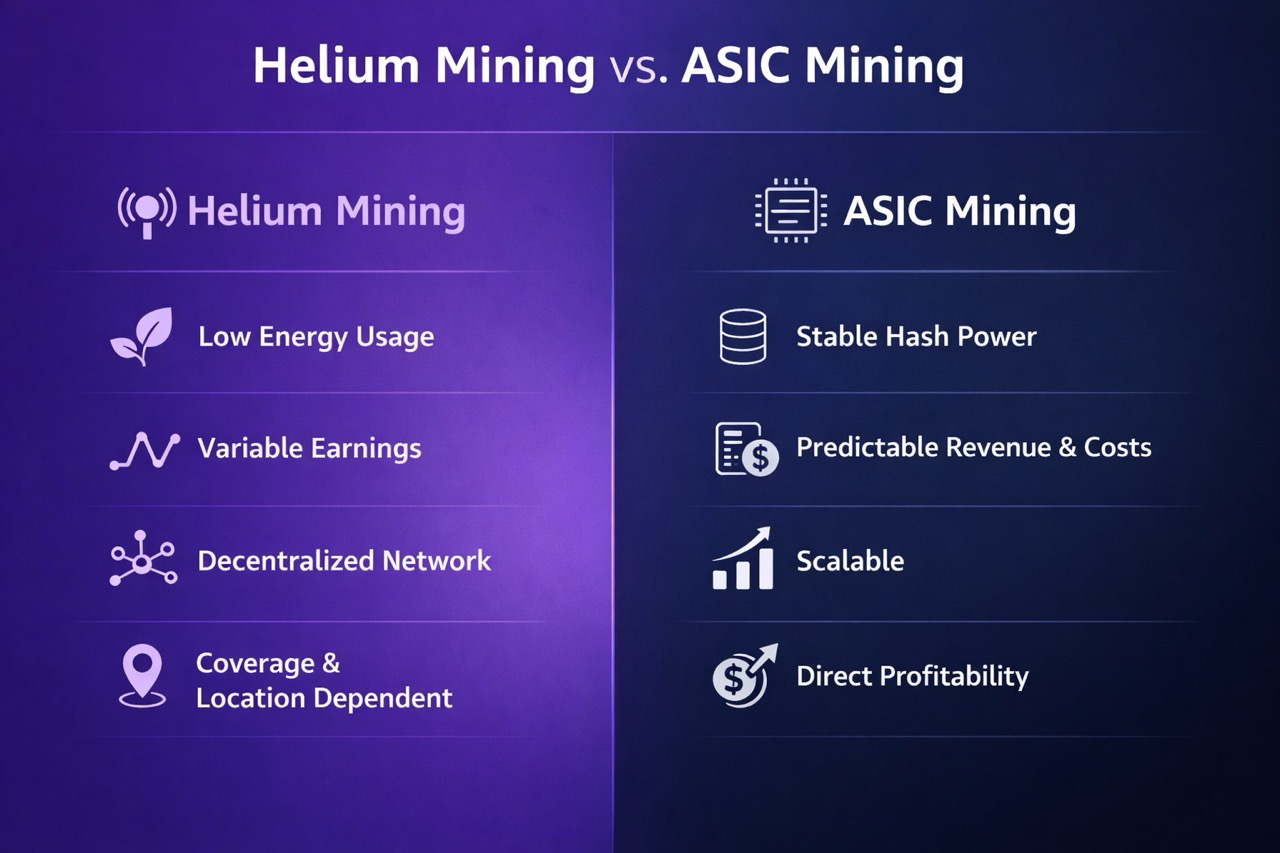
Difference from classic crypto mining
The biggest difference lies in the basic approach:
- Classic mining (e.g. Bitcoin): Computing power is used to solve cryptographic tasks
- Helium mining: Infrastructure is being built to provide real network coverage
These leads to clear differences:
- Very low power consumption
- No high-performance hardware required
- Location is more important than technology
- Revenue depends on network quality, not hashrate
It is precisely this approach that has made Helium Mining particularly interesting for beginners. At the same time, however, it is also the reason why economic efficiency has changed significantly — we will discuss this in detail later.
How does Helium Mining work technically?
Helium mining is not based on computing power, but on providing and verifying network coverage. Instead of solving complex math problems, helium hotspots perform a series of tasks within the network. In essence, it is about setting up a functioning radio network and making its quality verifiable.
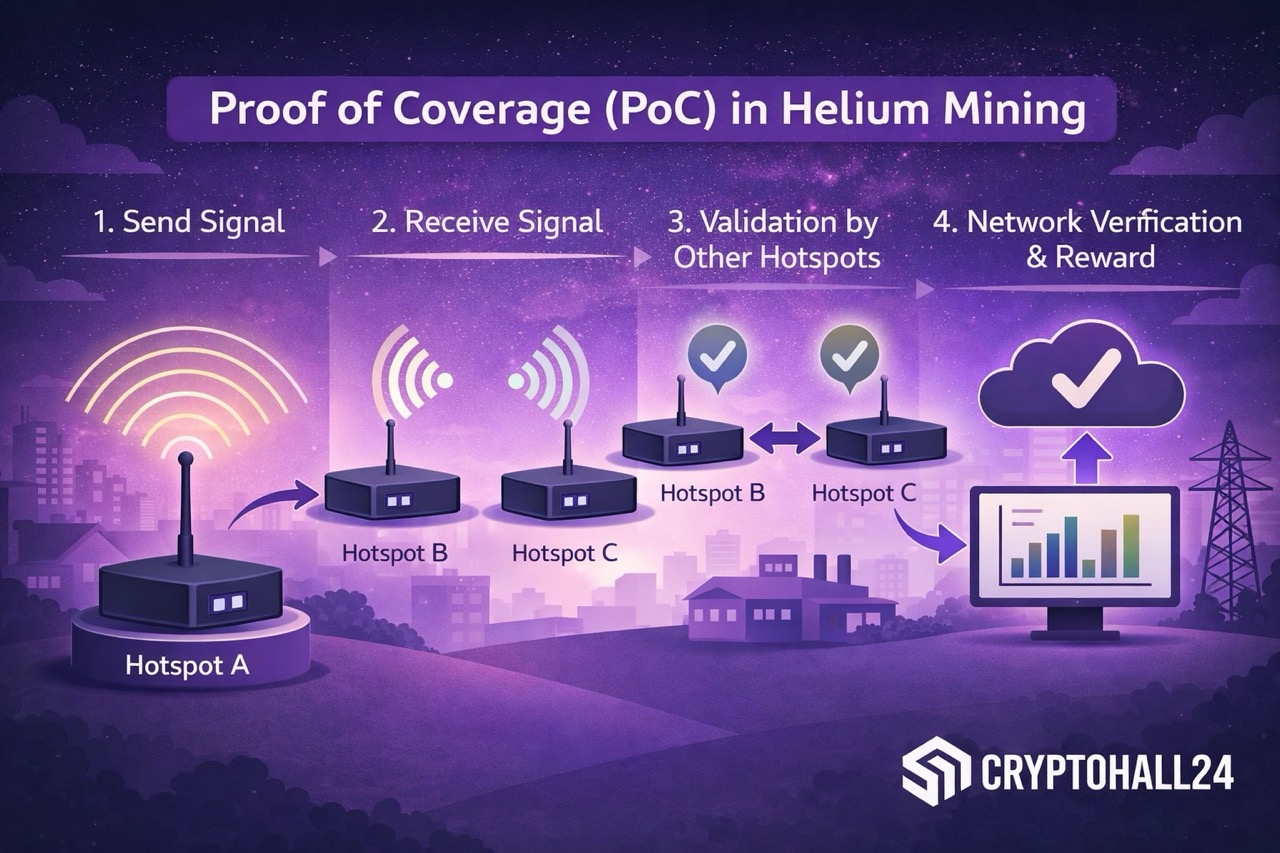
Proof of Coverage simply explained
The Central Concept in the Helium Network is the So-Called Proof of Coverage (PoC). In doing so, the network continuously checks whether hotspots actually provide wireless coverage.
The process is simplified:
- A Hotspot Sends a Radio Signal (Challenge)
- Other hot spots in the area receive this signal
- These confirm the range and position
- The Network Assesses the Quality of Coverage
The better positioned a hotspot is and the more other devices can confirm it, the higher the potential compensation.
Important: It is not about operating as many devices as possible, but about to deliver meaningful network coverage.
The Role of Hotspots in the Network
A Helium Miner performs several tasks at the same time:
- Provide wireless coverage
- Verify signals from other hotspots
- Forwarding data packets
This means that a single hotspot is part of a larger system and only works optimally if it is integrated into an existing network.
An isolated hotspot with no other devices within range barely generates any income.
Why Location is crucial
In contrast to ASIC miners, the decisive factor in helium mining is not the hardware, but the location.
Important influencing factors include:
- Antenna height
- Free Field of Vision
- Number of other hotspots within range
- Geographical location
This results in a special feature: Two identical devices can generate completely different revenue — just because of their location.

Difference from Classic Mining
Technically speaking, there is a clear difference:
- With Bitcoin or Litecoin, performance depends on the hashrate
- With Helium, Everything Depends on Network Coverage and Position
That means:
- Scaling is more difficult to plan
- Revenue is less predictable
- External Factors Play a Major Role
Is Helium Mining really mining?
Strictly speaking, helium mining is not classic mining. It is more of a Reward system for infrastructure development. The term “mining” is used here because:
- Tokens are generated
- Attendees Get Rewarded
- A decentralized system is being created
Technically speaking, however, it is closer to a Network operation with token incentive Than in classic crypto mining.
Which Helium Miners are there?
So-called hotspots are used for helium mining. These are specialized devices that provide radio coverage and participate in the Helium Network at the same time. In recent years, several manufacturers have established themselves who have produced corresponding helium miners. Technically, the devices usually differ only slightly — the location, antenna and network connection are more important.
Well-known Helium Miner Manufacturers
The most well-known devices on the market include:
- Bobcat Miner
- Nebra Miner
- SenseCap Miner
- RAK Hotspot Miner
These devices were developed specifically for the Helium network and support the LoRaWAN standard. They are generally compact, energy-efficient and designed for continuous operation.
Differences exist primarily in:
- Processing and Housing
- Firmware and user interface
- Delivery times and availability (a major issue historically)
However, actual network performance only depends on a limited extent on the manufacturer.
Helium Hotspot vs. Classic Miner
An important point that is often misunderstood: a helium miner is not a classic miner in the sense of ASIC or GPU mining.
- No competition over computing power
- No increasing difficulty due to hashrate
- No advantage due to “more performance”
Instead, every hotspot is technically similar — the difference is due to location and network connection. This also means that more expensive devices don't automatically deliver better results.
Helium Mining Routers and Hot Spots
Terms such as “Helium Mining Router” or “HNT Miner” are often used. In most cases, the same thing is meant: A device that:
- Provides wireless coverage
- Is connected to the Internet
- Forwards data
- Participates in Proof of Coverage
Some models also have:
- external antenna connections
- Better cooling for outdoor use
- extended configuration options
Hardware quality plays a bigger role, especially when used outdoors.
Which is the best Helium Miner?
This question is asked very frequently but can only be answered to a limited extent. The “best” helium miner does not primarily depend on the device, but on:
- Location
- Antenna height
- Visual connection
- Network competition
In many cases, a well-placed cheap miner can earn more than an expensive device in a bad location. This is a key difference to classic mining and one of the reasons why results can vary significantly.
Why Hardware is less relevant today
In the early stages of the Helium Network, the Choice of Device was an even bigger factor, primarily due to availability and firmware. The situation is different today:
- Most devices are technically sophisticated
- Differences in operation are minimal
- The network has become significantly denser
The focus is therefore no longer on hardware, but on:
- Network expansion
- Site optimization
- Real use of the network
Helium Mining Setup — Location, Antenna and Range
The decisive factor in helium mining is not the hardware, but the setup. While in classic mining, performance is determined by hardware, success in helium mining depends largely on how well a hotspot is positioned in the network.
Why Location is crucial
Location is the most important factor influencing revenue. A helium miner only works optimally if it can communicate with other hotspots.
To do this, he must:
- Be within range of other devices
- Have as few obstacles as possible between yourself and other hotspots
- Ideally be placed in an elevated position
A poorly placed miner, for example in a cellar or behind thick concrete walls, will barely be able to send or receive signals. This directly results in lower or no income at all.
Helium Mining in the Countryside vs. City
A frequently discussed topic is the question of whether helium mining is more worthwhile in the city or in the countryside.
City:
- Many hot spots nearby
- High Network Competition
- Lower Individual Rewards
Country:
- Less competition
- longer range possible
- Network density is often too low
In many cases, the optimal setup is in between. A location with a sufficient but not excessive density of hotspots offers the best conditions. Too many devices in an area cause rewards to split up.
Which Antenna do you need for Helium Mining?
In addition to the location, the antenna plays an important role. Many helium miners are delivered with simple antennas as standard. These are sufficient to get you started, but not always optimal.
Important factors for antennas:
- Gain (dBi) - Determines the range and orientation
- Installation height
- Free Line of Sight
A stronger antenna can increase the range, but it's not a panacea. In densely built-up areas, an antenna that is too strong can even have disadvantages, as signals can “shoot over” other hotspots.
Understanding Range and Network Card
In order to evaluate their own location, many miners use so-called network cards such as Helium Explorer. There you can see:
- How many hotspots are active in the area
- How dense the network is
- What are the distances between the devices
This is crucial in order to be able to realistically assess whether a location is suitable. A common mistake is to operate a miner without first analyzing the network situation.
Why the Setup is often underrated
Many beginners focus on hardware and expect the miner to “just run.” In practice, however, it is clear that without a well-thought-out setup, even the best hardware barely produces results. This makes helium mining difficult to plan and is one of the reasons why income can fluctuate significantly.
Helium Mining Costs and how to get started
Getting started in helium mining was comparatively cheap for a long time. In contrast to ASIC miners or GPU rigs, you don't need any powerful hardware and only have very low running costs. The most important costs are:
Purchase Costs for Helium Miners
Depending on the model and availability, a typical helium miner costs:
- approx. 300€ to 800€ per device
- In some cases significantly more during high demand
In addition, costs may arise for:
- Antenna upgrades
- Cables and adapters
- Outdoor housing when installed externally
Especially in the initial phase of the network, many devices were difficult to access, which in some cases significantly increased prices.
Current Costs
The running costs of helium mining are minimal:
- Power consumption: usually less than 10 watts
- Electricity costs: often just a few euros per month
- Internet Connection: Existing Connection Sufficient
That was one of the main reasons why helium mining was attractive to many users.
Can you start Helium Mining for free?
Terms such as “free helium miner” or “free helium mining” are not realistic in practice. Even though running costs are very low, you always need:
- hardware
- A suitable location
- Internet connection
It is therefore not possible to get started completely free of charge.
How much can you earn with Helium Mining?
This question is the central issue for most users. However, the answer has changed significantly in recent years.
Earnings earlier vs. today
In the initial phase of the Helium Network:
- High Rewards
- low competition
- Quick return on investment possible
The situation is different today:
- Significantly more hotspots in the network
- Lower rewards per device
- strongly fluctuating income
Realistic Assessment
The income is currently on many setups:
- Often only a few euros per month
- In some cases significantly below
In many cases, there is no longer a return on investment, especially with new installations.
Helium Mining Problems — why it's harder today
In addition to the drop in revenue, there are several structural problems that make helium mining difficult.
Network Saturation
The network is significantly expanded in many regions. These results in:
- Many Hotspots Share Rewards
- lower revenue per device
- Less growth potential
Low real Usage
A key issue is the actual use of the network. The concept is based on the fact that:
- Companies use the network
- Data is transferred
- This creates value
In practice, however, usage is often lower than expected. Without real demand, economic potential remains limited.
Decreasing Profitability
The combination of more participants, fewer rewards, and low usage has significantly reduced profitability. Many miners today operate their devices out of interest rather than for economic reasons.
Technical and Operational Hurdles
There are also challenges such as:
- Complex location optimization
- Network configuration
- Firmware issues with individual devices
This makes getting started more difficult than often assumed.
Is Helium Mining 2026 Still Worth It?
The clear answer depends heavily on expectations.
When it can still be useful
Helium mining can still be interesting if:
- A good location already exists
- Several hotspots can be combined sensibly
- The project is interesting from a technical point of view
When it doesn't make sense
For most new users, the following applies:
- low income
- Long or no payback
- High Dependence on External Factors
In many cases, starting with purely economic motivation is no longer useful.
Realistic Assessment
Helium is an interesting concept with a clear technical approach.
However, in the current market situation, it is:
- Difficult to plan
- barely scalable
- Often not economically attractive
Alternative to Helium Mining: Classic Crypto Mining
When the focus is on predictable and economic mining systems, there are clearly structured alternatives.
Difference: Infrastructure vs. Computing Power
Helium is based on:
- Network building
- Site optimization
Classic mining is based on:
- Computing power
- Energy Efficiency
- Clearly measurable key figures
Bitcoin Mining (SHA-256)
- established market
- Clear performance values
- Heavily dependent on electricity costs
Scrypt Mining (Litecoin & Dogecoin)
- stable alternative
- Combined Rewards (Merged Mining)
- Well scalable
Why ASIC Mining is more predictable
Compared to helium:
- Income can be calculated more easily
- Scaling is easier
- Less dependency on location
This makes classic mining systems significantly more structured in the long term.
Conclusion: Helium Mining is an exciting Approach — but economically limited
Helium mining was an innovative entry into the world of crypto mining over a long period of time. The approach of setting up a decentralized radio network and rewarding subscribers for it made technical sense and attracted many users.
In practice, however, the model has changed.
- The Network Is Highly Saturated in Many Regions
- Actual use remains limited
- Revenues have fallen significantly
Helium mining can continue to work for existing setups, especially in good locations. However, it is difficult for new beginners today to achieve an economically meaningful return on investment. The key point is: without real demand for the network, long-term performance also remains limited. Helium is therefore less of a classic mining model, but more of an infrastructure project with token incentives.
Alternative: ASIC Mining as a predictable Solution
When the focus is on mining with clearly calculable performance and stable framework conditions, classic ASIC miners are the much more structured option. In contrast to helium, ASIC mining is based on measurable factors:
- fixed payouts
- Defined power consumption
- Direct dependence on electricity costs and market prices
That means:
- Better predictability
- easier scaling
- Clearer profitability calculation
Especially in the area of Bitcoin, Litecoin and Dogecoin mining, stable systems have developed over the years that are significantly easier to control than decentralized infrastructure models such as helium.
Understanding Mining with a clear Framework
If you are serious about mining and want to understand which systems are useful and profitable today, it is worth taking a look at classic ASIC solutions. :
- Bitcoin Miner (SHA-256)
- Scrypt Miner for Litecoin and Dogecoin
- Hosting solutions for larger setups
With Cryptohall24 in ASIC Miner Store Find current devices and the respective performance data. Support in planning and implementing ASIC mining can be obtained from us via Contact form.
FAQ - Helium Mining
What is helium mining?
Helium Mining is based on operating hotspots that provide a decentralized radio network for IoT devices and are rewarded with HNT for this.
How does helium mining work exactly?
Hotspots send and receive radio signals, verify other devices on the network, and participate in the proof of coverage to prove their network coverage.
What is a helium miner?
A Helium Miner is a hotspot that provides wireless coverage, transmits data and participates in the network.
What is the difference between helium mining and classic mining?
Traditional mining uses computing power. Helium mining is about infrastructure and network coverage.
What is proof of coverage (PoC)?
A mechanism in which hotspots check each other whether they actually provide wireless coverage.
What is Helium Coin (HNT)?
HNT is the native token of the Helium Network and is paid out as a reward for provided infrastructure.
How much can you earn with Helium Mining?
Revenue is currently often only in the low single-digit euro range per month and varies significantly depending on the location.
Is Helium Mining 2026 Still Worth It?
For new beginners, it is no longer economically viable in most cases.
Why did helium mining revenue fall?
Due to an increasing number of hotspots, lower rewards and limited real use of the network.
Which helium miners are there?
Well-known devices include Bobcat, Nebra, SenseCap and RAK Hotspots.
Which is the best helium miner?
Hardware is less important than location and network connection.
Can you start helium mining for free?
No, as hardware, location, and Internet connection are required.
How much does a helium miner cost?
Typically between €300 and €800, depending on model and availability.
How high are the electricity costs of helium mining?
Very low power consumption, usually less than 10 watts.
How long does it take for a helium miner to pay for itself?
In many cases, no longer at all or only over very long periods of time.
What role does the location play in helium mining?
Location is the most important revenue factor as it determines network coverage.
Does helium mining make sense in rural areas?
Only if enough other hotspots are within reach.
Is Helium Mining Better in the City?
Not necessarily, as too many hotspots can split up rewards.
Which antenna do you need for helium mining?
It depends on the location. Range, height and unobstructed visibility are important.
How far does a helium miner go?
Depending on the antenna and environment, several kilometers, significantly more in optimal conditions.
Can you operate multiple helium miners?
Yes, but only useful if they are strategically distributed and not too close together.
How many helium miners are there worldwide?
The network comprises several hundred thousand hotspots worldwide.
What happens if there are too many miners in an area?
Revenue is divided and falls per device.
Can Helium Mining be scaled?
Only to a limited extent, as location and network constellation are decisive.
Which Internet connection does a Helium Miner need?
A stable connection with low bandwidth is sufficient.
Can you do helium mining without the Internet?
No, as the Hotspot must constantly communicate with the network.
How is helium mining taxed?
It depends on the country. In many cases, income is considered taxable.
Is helium mining legal?
Yes, it is legal to operate in most countries.
What is a helium hotspot?
A device that provides wireless coverage and participates in the network.
What is LoRaWAN?
A radio standard for energy-efficient data transmission over long distances.
Why does helium need its own network?
To provide a decentralized infrastructure for IoT applications.
Who Uses the Helium Network?
Companies, developers and applications in the area of IoT and sensors.
Why is network usage important?
Without use, there is no sustainable income for miners.
Can helium mining be automated?
Operations are largely automated, but location and setup require planning.
Are there alternatives to helium mining?
Yes, Bitcoin mining and scrypt mining in particular offer better predictability.
Why is ASIC mining more predictable than helium mining?
Because performance, power consumption and revenue are easier to calculate.
What is Bitcoin mining?
A process that uses computing power to validate transactions and generate new coins.
What is scrypt mining?
A mining process for coins such as Litecoin and Dogecoin.
Which is better: Helium Mining or ASIC Mining?
For predictable revenue and scaling, ASIC mining is usually the better choice.
Can Helium Mining be used as passive income?
Previously partly possible, but today it is usually no longer economically relevant.