Filters
Thank you! Your submission has been received!
Oops! Something went wrong while submitting the form.
Our products


No results available.
There are no results with these criteria. Try changing your search.


Yes, Aleo (ALEO) can be mined - but mining here works fundamentally differently than with Bitcoin. Instead of solving hash puzzles, the devices generate zero-knowledge proofs (zkSNARKs) through a process called Proof of Succinct Work (PoSW), thereby securing the network; in return they receive new ALEO as a reward. Aleo miners are therefore also called "provers".
This particularity makes Aleo its own mining case: it is a privacy layer-1 blockchain in which generating cryptographic proofs is precisely the miners' work. Mining is done with specialized zkSNARK ASICs from the IceRiver AE series. How this works in detail and what hardware is needed are covered in the following questions as well as in our Aleo miner overview.
Aleo (ALEO) is a layer-1 blockchain that does not add privacy as an afterthought but builds it in from the ground up via zero-knowledge proofs - the mainnet launched in September 2024. Transactions are encrypted by default; the network only verifies a cryptographic proof that an application was executed correctly, without seeing the underlying data itself. Development is done in Leo, its own language modeled on JavaScript and TypeScript.
For miners, Aleo is interesting above all because this privacy approach requires its own type of mining: no SHA-256 hashes are computed, but proofs are generated via Proof of Succinct Work. That is exactly what makes specialized hardware such as the IceRiver AE series necessary - more on this in the following questions.
Aleo is a special case: here no hash puzzles are solved, but zero-knowledge proofs (zkSNARKs) are generated - compact cryptographic attestations that a computation was carried out correctly. This process is called Proof of Succinct Work (PoSW), and Aleo miners are therefore called "provers".
The goal is the same as with any proof-of-work coin - securing the network and putting new coins into circulation -, only the work is different: whoever contributes a valid proof helps create blocks and receives a reward in ALEO. Performance is accordingly measured not in classic hashrate but in proofs generated per second, usually expressed in MH/s or GH/s. Here too, provers mostly join pools in order to smooth out earnings.
Proof of Succinct Work (PoSW) is Aleo's mining process. Instead of solving pointless hash puzzles like Bitcoin, the miners generate zero-knowledge proofs (zkSNARKs) - that is, "succinct" cryptographic attestations that can be verified quickly and at the same time carry the network's privacy functions.
For you as a miner this means a practical difference: your performance is not stated in TH/s as with Bitcoin, but in MH/s or GH/s of generated proofs. And because PoSW relies on generating proofs rather than on SHA-256, it requires its own generation of specialized hardware such as the IceRiver AE series - normal Bitcoin miners cannot mine Aleo.
Aleo mining is not based on a classic hash algorithm like SHA-256 or Scrypt, but on the zkSNARK-based Proof of Succinct Work (PoSW). The devices therefore do not compute hashes in the conventional sense, but generate zero-knowledge proofs - that is the cryptographic task the entire Aleo hardware is optimized for.
For this reason Aleo also cannot be mined with the hardware of other coins: a Bitcoin or Litecoin ASIC can do nothing with this computing task. Anyone who wants to mine Aleo needs zkSNARK devices built specifically for generating these proofs - such as the IceRiver AE series.
With Bitcoin and similar coins, the hashrate describes how many hash attempts a device performs per second. With Aleo there is no such puzzle: here the miners generate zero-knowledge proofs via Proof of Succinct Work, which is why performance is measured as the amount of proofs generated per second - usually expressed in MH/s or GH/s.
In everyday use people still loosely speak of "hashrate", but what is meant is the proof performance. Important for you as a buyer: Aleo devices can only be compared with one another on the basis of this proof performance and their power consumption - a direct comparison with the TH/s figure of a Bitcoin miner makes no sense.
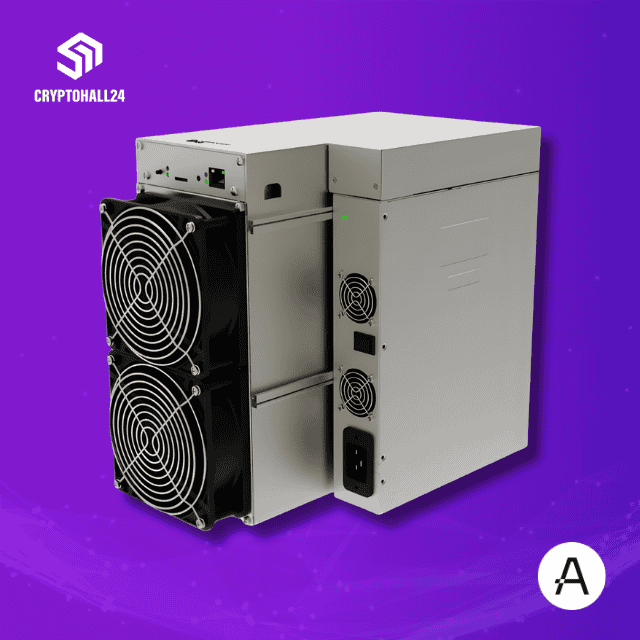
Aleo mining requires specialized zkSNARK ASICs whose chips are built exclusively for generating the Aleo proofs (Proof of Succinct Work). The devices currently common come above all from IceRiver (AE series, such as the IceRiver AE3) and Goldshell. In addition, Aleo can in principle still be mined with powerful graphics cards, though this has been significantly less efficient since the ASICs became available.
Such a zkSNARK ASIC masters only this one task, but does so especially economically per watt - and that is exactly what it takes today to stay competitive in the Aleo network. Which models specifically come into question is shown in our Aleo miner category.
Aleo started out in its testnet phase as a GPU coin and saw a veritable mining gold rush there. Technically, Aleo can still be mined with powerful graphics cards today - but since the mainnet launch in September 2024 and the availability of specialized zkSNARK ASICs such as the IceRiver AE series, GPU mining is practically no longer economically competitive.
The reason is the large efficiency gap: a PoSW ASIC generates the proofs many times more economically per unit of power than a graphics card. With the increased network difficulty, a GPU rig's share is correspondingly small. GPU mining is therefore more suited to experimenting or to using existing hardware than to economically optimized continuous operation.
For economically oriented continuous operation, a zkSNARK ASIC of the IceRiver AE series is usually the better choice for Aleo, because it delivers many times the proof performance of a graphics card per watt used. On the decisive cost factor of electricity, the ASIC is therefore clearly ahead.
Graphics cards come into question more when the hardware is on hand anyway, electricity is very cheap, or flexibility is needed - such as later switching to another GPU-mineable coin, since an Aleo ASIC is hard-wired to Proof of Succinct Work. Anyone betting on Aleo permanently and in quantity is usually much more efficient with a specialized ASIC.
With Aleo mining, the hardware determines the software. On a zkSNARK ASIC of the IceRiver AE series, the control is present ex works - you open the device interface in the browser, enter pool and ALEO wallet address, and the device takes up the Proof-of-Succinct-Work proving.
If, on the other hand, you rely on GPUs, dedicated mining software on the computer that supports Aleo's proving is mandatory. Several ASICs can be bundled via a central monitoring software; for getting started with a single AE device, the supplied firmware is sufficient.
Available are specialized zkSNARK ASICs - above all the IceRiver AE series (such as the IceRiver AE3, which comes as a quieter home model and as a more powerful variant with around 2 GH/s, as well as the more compact AE2) and Goldshell models such as the AE Box and the Goldshell AE Max. In addition, Aleo can be mined with powerful graphics cards. The models currently available are shown at the top of this page.
At Cryptohall24 you order the right Aleo miners directly - new or as a tested used device. Which device suits you depends on whether you want to mine at home and how high your budget is - the small, quiet devices are suitable for home use, the larger ones for continuous operation with more proof performance. We are happy to advise you on this.
With the zkSNARK coin Aleo, the range goes from smaller home devices such as the Goldshell AE Box in the lower segment up to powerful ASICs such as the IceRiver AE3 with around 2 GH/s in the upper range. Where a device falls exactly depends on its proof performance (MH/s or GH/s) and efficiency.
Aleo is a young coin with a volatile price, which is why the pure acquisition is hard to view in isolation - the interplay of hardware costs, power consumption, and expected ALEO yield fluctuates accordingly. The current prices of the individual models can be seen at the top of this page.
The biggest lever here is the price advantage: because Aleo mining is still young, used IceRiver AE3 units deliver the full proof performance at an often significantly lower price than new ware. At Cryptohall24 you also find tested used devices for Aleo mining.
What you should watch out for: early AE-series or Goldshell models work less efficiently and consume more power per proof generated - with expensive electricity the price advantage then quickly melts away again. The decision between new and used comes down to the triangle of purchase price, efficiency, and electricity price. Talk to us, we help with classifying your Aleo miner options.
With Proof of Succinct Work, Aleo uses an unusual approach in which the computing work itself serves to generate zero-knowledge proofs - this is mined via a zkSNARK ASIC such as the IceRiver AE3, which pays out rewards on an ongoing basis. Anyone who only wants to hold ALEO, on the other hand, buys the coins ready-made at the current price via a crypto exchange such as Bitget, provided ALEO is traded there.
Buying takes effect immediately and depends solely on the entry price. Mining is the ongoing generation, whose yield is determined by electricity price, ALEO price, and difficulty. Cryptohall24 sells the zkSNARK hardware; the ALEO trading itself is handled by the exchanges - a classification of both paths is given by our crypto exchange comparison.
A home miner for Aleo is a device designed for operation at home - quieter, more compact, and with lower power draw than the large industrial ASICs. With Aleo this includes, for example, the smaller IceRiver AE models and the Goldshell AE Box, which can also be operated in a living environment.
Such devices generate fewer proofs per second than the powerful industrial variant, but are more suitable for everyday use in return. They are suitable for beginners who want to try out Aleo mining themselves or operate it on a small scale - unlike with some coins, Aleo therefore actually has home-suitable devices.
Aleo miners today are consistently air-cooled. The current devices for Proof of Succinct Work - such as the IceRiver AE series - regulate their temperature via built-in fans; a hydro variant with a water circuit is not on offer for Aleo.
Thus the environment determines the result: sufficient fresh air, a clear exhaust path, and a setup location where the waste heat can dissipate quickly. Which device class makes sense depends on noise level and power draw at the respective location - the cooling type itself, however, remains consistently classic air cooling with Aleo.
How loud an Aleo miner is depends strongly on the device. The more powerful zkSNARK ASICs of the IceRiver AE series are loud, because they dissipate their waste heat via powerful fans in continuous operation - the volume is then typically in the range of a vacuum cleaner, which is why an ordinary living space is usually not suitable for it.
Unlike with many coins, however, Aleo has quieter alternatives: smaller AE devices built specifically for home use and the Goldshell AE Box work considerably more muted and are thereby home-suitable. Anyone who wants to avoid the noise entirely places the device in a quiet spot such as a basement or garage.
Any arbitrary crypto wallet is not enough for Aleo mining - the privacy model of the Aleo blockchain requires an ALEO wallet designed for it. Established are the Leo Wallet and the Puzzle Wallet, each as a browser extension as well as for iOS and Android.
You enter their receiving address in the mining pool so that the rewards from Proof of Succinct Work arrive there. The private key, and thus access to your ALEO holdings, remains exclusively with you.
As a wallet for your Aleo payouts (ALEO), the Leo Wallet and the Puzzle Wallet are established above all, each as a browser extension as well as an app for iOS and Android. With Shield, a newer wallet has also been added. These wallets are specifically designed for Aleo's zero-knowledge privacy model.
What matters is that you choose a wallet that supports ALEO directly - any arbitrary crypto wallet is not necessarily sufficient because of the particularities of the Aleo blockchain (encrypted records, view keys). The private key, and thus access to your ALEO holdings, remains exclusively with you.
Aleo is mined via Proof of Succinct Work, and a dedicated pool ecosystem has formed around this young coin; among the well-known points of contact are F2Pool, DxPool, and Luxor. The providers differ above all in fee, payout model, and minimum payout.
Because the Aleo network is still comparatively young, fees, terms, and the supported devices change faster than with established coins. A current comparison directly at the respective pool is therefore mandatory before choosing, instead of relying on older overviews.
With Aleo, the best pool depends first on it reliably supporting your specific device - such as an IceRiver AE3; only after that do fee, payout model, and minimum payout become the benchmark. With small proof performance, a larger pool ensures more even payouts.
Because the Aleo network is still young, the pool landscape changes faster than with established coins. Solid entry-level addresses are F2Pool, DxPool, and Luxor. First check the device support, then compare the criteria, and check the terms daily at the provider.
Aleo works differently than classic ASIC coins: via Proof of Succinct Work you contribute valid proofs instead of searching for pure hashes. Solo mining is possible - but with a single IceRiver AE3 the chance of the full reward is very low.
Because your proof performance competes against that of the entire network, long phases entirely without yield arise in solo operation. Almost all Aleo miners therefore join a pool such as F2Pool or DxPool, which bundles the contributions of all participants and enables regular payouts. Only with very large proof performance of your own does solo become a serious option with Aleo.
With Aleo mining, the power draw fluctuates strongly with the device: compact home ASICs such as the Goldshell AE Box move roughly around a few hundred watts, while more powerful zkSNARK devices such as the IceRiver AE3 in the 2-GH/s variant tend to be around 1 to 2 kW; a GPU setup also draws noticeable power in continuous operation. Across all paths, electricity remains by far the largest ongoing cost factor, because computing happens around the clock.
What is decisive is not the pure wattage, but the ratio of proof performance to consumption. The electricity price is therefore the most important profitability lever, which is why mining is often done at locations with cheap energy. Check the exact power draw of your model on the data sheet before buying.
No, Aleo does not have a halving in the Bitcoin sense, but a declining inflation model. The network launched its mainnet in September 2024 with around 1.5 billion tokens, and the emission rate decreases gradually over the years - from about 13.5 percent in the first year to around 1.6 percent in the tenth year.
For Aleo miners this means a gradual decline of the newly distributed ALEO over time, instead of an abrupt halving as with Bitcoin. The further the emission falls, the more important the efficiency of the hardware and a cheap electricity price become. Exact emission figures can deviate slightly depending on the source and should be verified before a purchase decision.
Aleo (ALEO) launched its mainnet in September 2024 with around 1.5 billion tokens and follows a declining inflation model that starts high and decreases over the years. New ALEO arise as a reward for two groups: provers, who generate the zero-knowledge proofs via Proof of Succinct Work (that is the part your miner handles), and validators, who secure the network.
For you as a miner this means: your share of the yield depends not only on the ALEO price, but also on how much proof performance is in the network in total and how high the current emission is. Both change, which is why a daily check is worthwhile. Exact supply and emission figures can deviate slightly depending on the source.
Whether Aleo mining is worthwhile in 2026 depends above all on the ALEO price, the network difficulty, and your electricity price. Aleo is a young privacy niche and technically fully mineable, but the margins fluctuate strongly because the ALEO price is volatile and the difficulty rises with the increasing spread of the zkSNARK ASICs.
Anyone who has cheap electricity and an efficient, current device such as the IceRiver AE3 can mine profitably under suitable conditions; with expensive household electricity the calculation quickly tips into the red. Calculate conservatively because of the price fluctuations. Most reliably, you run your scenario through in advance with a current mining calculator such as AsicMinerValue.
Aleo is a young zkSNARK coin, and precisely from this follows the biggest unknown in the yield: the ALEO price is low and strongly volatile, the difficulty rises with every device newly going onto the network. What your IceRiver AE3 brings in results from its proof performance in relation to the network difficulty - minus electricity and pool fee.
Since no fixed value is predictable, the rule of thumb applies: net yield = mined ALEO times price minus electricity costs. With a high electricity price this can become negative. Calculate conservatively and check your setup daily with a mining calculator. Note: we do not host the AE3 - you operate the device yourself.
Aleo is not classic hash mining, but proof generation - performance is stated in GH/s, with the IceRiver AE3 about 2 GH/s. Into a mining calculator you enter this proof performance, the device's power consumption, and your electricity price; the tool offsets this with the current ALEO price and network difficulty to arrive at the estimated daily or monthly yield.
The current profitability of the common Aleo models is shown by AsicMinerValue. Since price and difficulty change constantly, every result is only a snapshot - check your scenario again shortly before buying.
Aleo is among the most home-suitable mining coins of all: the compact AE devices and the Goldshell AE Box are quiet and economical enough to be operated without a separate technical room - the loud industrial hardware of other coins is eliminated here. Even the waste heat can be sensibly used as supplementary heating in winter.
Nevertheless, the electricity price remains the economic crux. With household electricity around 30 ct/kWh the margin is slim; Aleo mining at home becomes really interesting with a cheap tariff or surplus solar power from your own photovoltaic system, which would otherwise only go into the grid for a few cents. Because the AE devices are so frugal, self-operation is more worthwhile here than with power-hungry ASICs.
The IceRiver AE3 draws roughly 1 to 2 kW depending on the model and gives off this energy almost entirely as heat while generating ALEO via Proof of Succinct Work - so heating with it is possible, but with significantly lower heat output than a large industrial ASIC.
This is exactly the advantage with Aleo: the more economical, quieter AE models are more suited as supplementary warmth for a single room or a home office and disturb less there. With the more powerful AE variants, a quieter spot such as a basement or workshop is still worthwhile because of the noise. The economic lever is and remains the electricity price - with a cheap tariff or your own photovoltaics the heat falls off practically on the side, and the mining yields push down the heating costs.
Aleo is a layer-1 blockchain that builds in privacy from the ground up via zero-knowledge proofs. Transactions are encrypted by default; the network only verifies a cryptographic proof that an application was executed correctly, without seeing the input data itself. Development is done in Leo, its own language modeled on JavaScript and TypeScript.
Aleo is used, among other things, for confidential DeFi applications, digital identity (proving attributes without disclosing personal data), and private payments, in which authorized parties can gain targeted insight via so-called view keys. For understanding as a miner, what matters is: precisely this privacy approach is the reason why Aleo requires its own type of mining hardware with Proof of Succinct Work.
Cryptohall24 does not host Aleo hardware of the IceRiver AE series: our data centers are designed for powerful industrial ASICs from Bitmain and MicroBT (Whatsminer), and IceRiver devices fundamentally do not fall into this hosting profile.
In practice this means for Aleo: you operate your AE miner yourself, for example at home - which the quieter, compact AE devices and the Goldshell AE Box are well suited for anyway. We are happy to sell and explain the hardware. How the hosting of industrial devices works in general and what matters with the location, you can read in the mining hosting guide.
No Aleo device is currently hostable: the IceRiver AE series and the available Goldshell models do not come from Bitmain or MicroBT and are in part very economical niche ASICs - such hardware Cryptohall24 currently does not take into the data center. We are happy to sell and explain them to you, however.
Our hosting runs with powerful industrial ASICs from Bitmain and MicroBT (Whatsminer), which work around the clock in the data center; the Aleo hardware, by contrast, is geared toward self-operation at home. Should you additionally want to operate a suitable industrial device, we are happy to clarify the hosting possibilities with you on a case-by-case basis.
What can be deducted with Aleo mining is above all the power consumption and the acquisition of the mining devices - as operating expenses they reduce the profit that is to be taxed. The prerequisite is regular operation with the intention of making a profit; then the German tax office treats the mining as commercial and the ALEO yields become taxable.
Aleo mining is permitted in Germany; in which country it is allowed and how it is taxed there sometimes differs strongly. How you optimally use the deductible items is covered by our article on how you reduce your taxes through crypto mining. You clarify your individual situation with an advisor - this is not tax advice.
No. An Aleo ASIC such as the IceRiver AE3 generates zkSNARK proofs (Proof of Succinct Work) and thereby solves a fundamentally different task than classic hash algorithms - with Bitcoin (SHA-256) or Litecoin (Scrypt) it has nothing in common, so these coins cannot be mined with it.
Via GPU you are somewhat more flexible, since a graphics card can be switched to various GPU-mineable algorithms depending on the model; a specialized Aleo ASIC, by contrast, remains limited to proof generation. Hardware for other coins you can find in the ASIC miner category.