Filters
Thank you! Your submission has been received!
Oops! Something went wrong while submitting the form.
Our products


No results available.
There are no results with these criteria. Try changing your search.


Ethereum Classic sticks to the proof-of-work algorithm, which makes it more stable and predictable for miners compared to Ethereum, which switched to proof-of-stake.
Bitmain Antminer E11 — ~9 GH/s
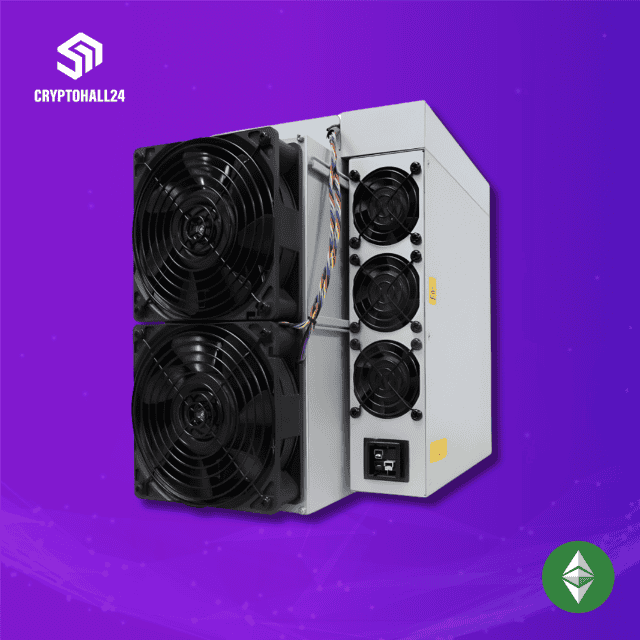
The E11 is currently the most powerful device for mining Ethereum Classic (ETC) — with around 9 GH/s of computing power based on the Ethash algorithm.
Many older devices are no longer available or have been replaced by more powerful models. These include:
Bitmain:
Jasminer:
iPollo:
Innosilicon:
These devices are no longer available from Cryptohall24. They have either been replaced technically or no longer meet today's requirements for hashrate, efficiency and power consumption to a sufficient extent.
There are other models for Ethereum Classic Mining internationally, especially from manufacturers such as Jasminer or iPollo. However, many of these devices are currently no longer available or are only economically viable to a limited extent. Cryptohall24 therefore deliberately focuses on selected models that are convincing in terms of power consumption, stability and availability.
Yes, Ethereum Classic (ETC) can be mined and is one of the most important proof-of-work coins left after the 2022 Ethereum Merge - when ETH switched from proof of work to proof of stake, ETC became the most significant refuge for the freed-up mining hardware. It is mined using the Etchash algorithm, with a device providing computing power around the clock and receiving new ETC as a block reward in return.
A particular feature of Ethereum Classic is its hardware history: graphics cards once dominated, today specialized Etchash ASICs such as the Antminer E series run the network. How mining works in detail, what hardware is needed and what matters with pool and wallet are covered by the questions below as well as our Ethereum Classic miner overview.
Ethereum Classic (ETC) is the original Ethereum blockchain, which emerged in 2016 after the split of the Ethereum community over the DAO hack and has stayed true to the principle "Code is Law". While today's Ethereum (ETH) changed course and moved to proof of stake in 2022, Ethereum Classic kept the proof-of-work principle - and is therefore still mineable.
For miners, ETC is relevant above all because, after the Ethereum Merge, it is one of the largest remaining proof-of-work networks for former Ethereum hardware. ETC uses the Etchash algorithm and can in principle be mined with graphics cards or the specialized Etchash ASICs of the Antminer E series.
No, Ethereum (ETH) can no longer be mined since September 2022. With the so-called Merge, Ethereum switched from proof of work to proof of stake - since then no new ETH is created through mining, but distributed via staking.
Anyone who still wants to mine an Ethereum-related cryptocurrency usually turns to Ethereum Classic (ETC). Ethereum Classic is the original chain that stayed with proof of work and uses a related algorithm in Etchash, so that earlier Ethereum mining hardware - graphics cards as well as Etchash ASICs - can be reused for it. When people talk about "mining Ethereum" today, they almost always mean Ethereum Classic.
Ethereum Classic mining depends on a large data structure: the DAG, which constantly grows and must be loaded completely into the device's memory. That is exactly why the Etchash algorithm needs devices with plenty of memory - such as the Antminer E11 - instead of pure compute ASICs.
The basic principle is proof of work as with Bitcoin: the device continuously solves cryptographic tasks, and whoever finds a valid block at roughly 13 seconds block time receives the block reward in ETC (currently around 2.048 ETC per block). Because a single device hits only very rarely, almost all miners bundle their power in a pool such as ViaBTC or 2Miners. Mining brings new ETC into circulation and secures the network against manipulation.
Ethereum Classic mining is based on the Etchash algorithm - a memory-intensive computing task that emerged from Ethereum's original Ethash. Etchash works with the DAG (Directed Acyclic Graph), a large dataset that keeps growing and must reside entirely in the device's memory.
That is exactly why ETC can be mined both with graphics cards and with ASICs specialized for it, such as the Antminer E11 - GPUs need sufficient video memory (VRAM) to hold the growing DAG. Other coins sometimes use completely different algorithms (Bitcoin, for example, SHA-256), which is why their hardware is unsuitable for Ethereum Classic and vice versa.
For Ethereum Classic mining there are two routes: graphics cards (GPUs) or specialized Etchash ASIC miners. That sets ETC apart from coins like Bitcoin, which can only be mined with ASICs - historically ETC was a classic GPU coin, today ASICs dominate.
For serious operation, Etchash ASICs are the first choice because they deliver many times the computing power of a graphics card per watt. The reference device is the Antminer E11 from Bitmain with around 9-9.5 GH/s at about 2.4 kW; alongside it there is the older generation Antminer E9 Pro (3.68 GH/s, approx. 2.2 kW). Graphics cards are cheaper to get started with, but significantly less efficient - which route makes sense depends on electricity price, budget and quantity.
Yes, unlike many other coins, Ethereum Classic can still be mined with graphics cards - provided the card has enough video memory (VRAM) for the growing Etchash DAG. Older cards with too little memory drop out of mining over time, because the algorithm's memory requirement keeps rising.
After the 2022 Ethereum Merge a lot of GPU power moved to ETC, but economically GPU mining here is now significantly less efficient than an Etchash ASIC like the Antminer E11. On normal household electricity the yield per graphics card is low. GPU mining is therefore better suited as an entry point or for hardware you already own than for economically optimized continuous operation.
For economically oriented continuous operation, an Etchash ASIC is usually the better choice for Ethereum Classic, because it delivers many times the computing power of a graphics card per watt used. An Antminer E11 manages around 9-9.5 GH/s at about 2.4 kW - for that you would need a whole wall of GPUs with far higher power consumption.
Graphics cards are more worthwhile when the hardware is already on hand, electricity is very cheap, or flexibility is needed - such as later switching to another GPU-mineable coin, which is not possible with an ASIC hard-wired to Etchash. Anyone betting on Ethereum Classic permanently and in quantity is usually more efficient with ASICs.
That depends on whether you mine via ASIC or via graphics card. On an Etchash ASIC like the Antminer E11 you need no software of your own - you open the device's web interface, enter an ETC pool such as ViaBTC or 2Miners along with your Ethereum Classic wallet address, and the E11 starts running.
With GPU mining, on the other hand, real software on the computer is mandatory: Etchash-capable miners such as lolMiner or GMiner handle the hashing and the pool connection. For park operation with many E11s there is additionally management software for central monitoring; a single device gets by without it.
You can buy specialized Etchash ASICs - in the industrial segment above all the Antminer E series from Bitmain: the Antminer E11 (around 9-9.5 GH/s, approx. 2.4 kW) as the current reference device and the older generation Antminer E9 Pro (3.68 GH/s, approx. 2.2 kW). Beyond that, Ethereum Classic can be mined with powerful graphics cards. You will find the models currently available at the top of this page.
At Cryptohall24 you order the right ETC miners directly - new or as a tested second-hand device. Which device suits you depends on whether you want to mine at home or have it hosted, and how high your budget is; we are happy to advise you on this.
With Ethereum Classic, it is above all the device generation that separates the price classes: an older Antminer E9 Pro (3.68 GH/s) sits in the lower range, while the current industrial model Antminer E11 with around 9 to 9.5 GH/s is in the upper four-digit euro range. Decisive factors are hashrate and efficiency in J/MH.
Since ETC remained the only large Ethash coin for ASICs after the Merge, it is especially worth looking at the relationship between acquisition cost, electricity cost and ETC yield. You can see all listed models with their current price at the top of this page.
With Ethereum Classic, the generation makes the difference: the Antminer E9 Pro delivers its 3.68 GH/s on Etchash even when used, but works with a higher J/MH value than the newer Antminer E11. Exactly this efficiency jump determines whether the cheaper older device comes out ahead. Cryptohall24 carries tested second-hand devices for Etchash alongside new equipment.
A used E9 Pro plays out its lower purchase price above all with cheap electricity; as the electricity price rises, the more efficient E11 recovers that through its lower consumption. Which calculation works out for you depends on the price gap, J/MH efficiency and electricity price - get in touch, and we will compare the Ethereum Classic miners with you.
Mining Ethereum Classic means producing ETC yourself with an Etchash miner and continuously collecting block rewards - ETC remained one of the few large, still mineable coins after Ethereum's switch to proof of stake. Anyone who simply wants to own ETC, on the other hand, buys it at the current price on a crypto exchange such as Bitget or Binance.
Buying takes effect immediately and depends solely on the entry price. Mining is an ongoing activity whose yield depends on electricity price, ETC price and difficulty - with the influx of former Ethereum miners noticeably shaping the Etchash difficulty. Cryptohall24 sells the right hardware and offers hosting; the ETC trading itself is handled by the exchanges.
A home miner for Ethereum Classic is a device designed more for operation at home - quieter and more economical than the large industrial ASICs of the Antminer E series. With ETC, this category falls above all to GPU mining or individual more compact Etchash devices, since the Antminer E11/E9 Pro at around 75 dB are clearly industrial devices.
Such home solutions deliver less computing power than an Antminer E11 (9-9.5 GH/s), but are more suitable for everyday use. They are suited to beginners who want to try out Ethereum Classic mining themselves or run it on a small scale - whereas anyone mining seriously and in quantity can hardly get around an industrial ASIC.
For Ethereum Classic miners there are two cooling routes to choose from: air cooling as the normal case and hydro cooling for dense setups. Both mine ETC via Etchash with identical efficiency; the difference lies in noise and infrastructure.
The Antminer E11 as a typical Etchash device is air-cooled and expels its waste heat via four powerful fans - the standard for single setups. A Hydro miner dissipates the heat via a closed water loop, thereby works more quietly and packs more hashrate into a tight space at the same build size. In return it needs pumps, piping and a dry cooler - so it only pays off once many units stand densely side by side, as in an ETC mining setup with several devices.
An Ethereum Classic miner is loud - an air-cooled industrial ASIC like the Antminer E11 reaches around 75 dB in operation, roughly the level of a running vacuum cleaner, because its four fans have to dissipate the waste heat of around 2.4 kW in continuous operation. An ordinary living space is hardly suitable for this.
It only gets quieter with more economical alternatives such as a GPU setup with throttled fans - but that comes at the expense of profitability. Anyone who wants to avoid the noise entirely places the device in a quiet spot such as a cellar or garage, or has it hosted in a data center, where the noise level does not matter.
For Ethereum Classic mining you need an ETC wallet as a payout address - the pool sends the mined ETC directly to the address you store there. ETC uses exactly the Ethereum address format (0x...), which is why many ETH wallets handle Ethereum Classic right away.
Just make sure to actually select the Ethereum Classic network in the wallet - otherwise you confuse the chain with Ethereum. The private key to the wallet should be known only to you. For larger ETC holdings a hardware wallet such as Ledger is worthwhile, which supports Ethereum Classic and keeps the keys particularly secure offline.
Ethereum Classic has a broad pool landscape, because the coin took in many former ETH miners after the Ethereum Merge - widely used are ViaBTC, 2Miners, F2Pool, K1Pool and NiceHash. They differ from one another above all in fee, payout model and minimum payout.
With ViaBTC and NiceHash there are direct cooperations - signing up via our links brings reduced pool fees. Since fees and hashrate distribution with ETC are constantly in motion, it is best to check the conditions directly with the pool before you point your ASIC at it.
There is no blanket winner with Ethereum Classic - which ETC pool is right for you results from fee, payout model, minimum payout and pool size. The smaller your hashrate, the more a large pool is worthwhile, because it smooths out the payout fluctuations.
Good for getting started are ViaBTC and NiceHash, with which we cooperate and via whose links you receive reduced fees. Compare your favorites against the four criteria and check the fees on a daily basis, since the conditions are constantly shifting.
Solo mining with Ethereum Classic is possible, but has become significantly harder since the 2022 Ethereum Merge: the computing power that migrated over from the shut-down ETH mining has driven the ETC network hashrate massively upward.
Against this bundled competition your single Antminer E11 stands alone - in the event of a block find you would indeed get the full reward of around 2.048 ETC, but hits are so rare that long unprofitable phases are the rule. That is why practically all ETC miners mine via a pool such as ViaBTC or 2Miners and receive regular payouts there instead of waiting. Solo only becomes a serious option with a very large hashrate of your own.
Around 2.4 kW: that is how much the current Etchash ASIC Antminer E11 draws continuously, which in 24/7 continuous operation amounts to about 21,000 kWh per year - a GPU setup comes out similarly high or above, depending on the number of cards. Electricity is thus by far the largest ongoing cost factor in Ethereum Classic mining.
How high the consumption turns out exactly is decided by the efficiency in J/MH: the E11 at around 0.26 J/MH is significantly more economical than the older E9 Pro at about 0.6 J/MH. The electricity price is therefore the most important profitability lever - with household electricity around 30 ct/kWh continuous operation becomes expensive, which is why mining is often done at locations with cheap energy.
No, Ethereum Classic has no halving in the Bitcoin sense, but its own scarcity model called "5M20": roughly every five million blocks the mining reward falls by 20 percent. This mechanism reduces the issued ETC amount in regular steps, instead of halving it all at once as with Bitcoin.
For Ethereum Classic miners this means a gradual decline of the ETC reward per block over time - currently it stands at around 2.048 ETC. As with other proof-of-work coins, the further the emission falls, the more important hardware efficiency and a cheap electricity price become.
Unlike the original Ethereum, the total supply of Ethereum Classic is capped: the upper limit is around 210.7 million ETC. This fixed limit was deliberately introduced with the 5M20 emission model to make ETC a scarce currency modeled on Bitcoin.
New ETC arise exclusively through mining, and the issued amount falls through the stepwise emission reduction (minus 20 percent every five million blocks) over the years. This makes Ethereum Classic increasingly scarce over time - a difference from the uncapped ETH.
The security of a proof-of-work network depends on its total computing power: the more Etchash hashrate stands behind Ethereum Classic, the more elaborate and expensive an attack would be. ETC had phases with lower computing power around 2019/2020, during which several 51-percent attacks occurred.
Since the 2022 Ethereum Merge, a lot of former Ethereum mining power has shifted to Ethereum Classic. As a result the network hashrate has risen significantly, which has considerably improved security compared with the earlier years - an attack is far more costly today than at the times of the known incidents.
Whether Ethereum Classic mining is worthwhile in 2026 depends above all on the ETC price, the network difficulty and your electricity price. ETC is technically fully mineable and, since the Ethereum Merge, one of the largest remaining proof-of-work networks, but the migrated hashrate has made the margins tighter.
With cheap electricity and an efficient device like the Antminer E11 (around 0.26 J/MH) it is possible to mine profitably under the right conditions; with expensive household electricity the calculation quickly tips into the red, and an older E9 Pro or a GPU setup pays off even more rarely. You calculate your scenario most reliably in advance with a current mining calculator such as AsicMinerValue.
Ethereum Classic runs on Etchash, and the Antminer E11 is measured in MH/s - your yield is the ETC amount the E11 finds relative to the network difficulty, times price, minus electricity cost and pool fee. Because ETC price and difficulty fluctuate daily, no flat figure is credible.
What matters is the difference between mining yield and electricity cost: the same E11 writes black figures with cheap electricity and red ones with expensive electricity. What is left net at your electricity price you estimate with a mining calculator for the E11, which factors in hashrate, electricity cost and the current ETC price.
Since the Ethereum Merge the ETC network hashrate has grown noticeably, because many former Ethereum miners switched to Etchash - that directly suppresses how many ETC a single device reaches per day. What remains decisive is the ratio of your hashrate to the network difficulty plus pool share; an Antminer E11 delivers around 9-9.5 GH/s.
With a fluctuating ETC price there is therefore no fixed daily amount. The expected gross yield with your hardware is provided by a current mining calculator; after deducting the electricity cost your net yield remains.
Since the Ethereum Merge, Ethereum Classic is one of the few remaining GPU/ASIC coins on the Etchash algorithm - correspondingly dense is the network and correspondingly important the upfront calculation. Into a mining calculator you enter hashrate and consumption, for the Antminer E11 about 9-9.5 GH/s and around 2.4 kW, plus your electricity price; from this, with the current ETC price and difficulty, the estimated daily or monthly yield results.
The common Etchash models are shown by AsicMinerValue with up-to-date profitability. Price and difficulty change continuously, the result remains a snapshot - recalculate shortly before purchase.
Ethereum Classic mining at home is worthwhile above all when electricity is cheap. The Etchash ASIC Antminer E11 draws around 2.4 kW, and with household electricity around 30 ct/kWh too little of the yield usually remains - with a cheap tariff or your own solar power from a photovoltaic system, home operation becomes interesting, on the other hand.
Noise and waste heat also have to be considered: the E11 is a loud industrial device and belongs in a cellar or garage rather than the living room. Anyone who wants to run high quantities or maximize profitability is usually better off with hosting in a data center.
At around 2.4 kW power draw, an Antminer E11 sits between a home and a heavyweight device - and because an Ethereum Classic miner converts this energy almost entirely into heat, you can heat with it and mine ETC via Etchash at the same time.
The device is not quiet in doing so: the Etchash industrial ASICs reach around 75 dB, which is why a cellar, garage or workshop are the sensible places to set it up. Economically, the heating use pays off above all with cheap grid electricity or your own solar power - then the energy used not only heats, but the ETC yields offset part of the electricity cost.
The history of ETC difficulty is closely tied to the 2022 Ethereum Merge: when Ethereum switched to proof of stake, a large part of the freed-up mining power migrated to Ethereum Classic and made the difficulty rise sharply.
It measures how hard it is to find a valid block in the Etchash network, and is continuously adjusted to the total computing power so that the block time stays at around 13 seconds. More hashrate raises the difficulty, less hashrate lowers it.
Concretely, a higher difficulty means: less ETC per day and device. How much an Antminer E11 earns under the current state and your electricity price you best check on a daily basis with a mining calculator.
With Ethereum Classic mining, Cryptohall24 takes over the hosting of your Etchash ASIC - typically the Antminer E11 - in its own data centers: you buy the device, we take care of the slot, power supply and ongoing operation, ownership stays with you.
The appeal lies exactly where home operation fails: an E11 produces around 75 dB of noise and noticeable waste heat and quickly undermines profitability at household electricity prices. At an industrial location with a calculable kWh price, the ETC calculation becomes plannable, on the other hand. What to look for when choosing a host is summarized by our mining hosting guide.
The Antminer E11 is the device of choice: with around 9 to 9.5 GH/s at about 2.4 kW, this Etchash industrial ASIC from Bitmain is the machine currently shaping ETC mining - and it is exactly such continuously runnable industrial hardware that Cryptohall24 takes into hosting.
What does not go into the data center, on the other hand, are GPU rigs and very economical home devices; they are designed for self-operation, and we are happy to sell and explain those rather than host them. If you operate a different Ethereum Classic device, we are happy to check its suitability with you on a case-by-case basis.
Since Ethereum switched to proof of stake, Ethereum Classic has gained weight again as the remaining PoW chain for ASIC miners - legally, mining is permitted in Germany. In tax terms this means: anyone who mines ETC regularly and with the intention of making a profit via the E11 is running a business and taxes the proceeds accordingly.
The ongoing items - energy, hosting and the devices - can be deducted as expenses in doing so. Whether mining is legally permitted is regulated by each country itself, and the exact tax classification of your case is handled by a tax advisor. These remarks are of a general nature and are not tax advice.
Ethereum Classic mining runs on Etchash, which is why an Ethereum Classic miner can only mine Etchash coins - above all Ethereum Classic itself and the closely related ETHW (EthereumPoW).
With GPU mining you stay flexible, because a graphics card can be switched to various GPU algorithms depending on its video memory. An Etchash ASIC like the Antminer E11 cannot do that: it is hard-wired to this one task and therefore mines no Bitcoin (SHA-256) and no Litecoin (Scrypt). For other algorithms you need suitable devices, to be found in the ASIC miner category.